It’s not long until I leave the city again. GUPA (Glasgow’s caving club) is going on summer trip to Wales, and of course I cannot miss this. Not even if it means sitting in a car for 5 hours listening to Christian rock (courtesy of one Alex Parker).
Alex himself has to go on to Devon so I’m dropped by the roadside. A dirt track, where cows and sheep graze, leads to the hut of the Oxford Mountaineering Club. There is no doubt about it: this is Wales.
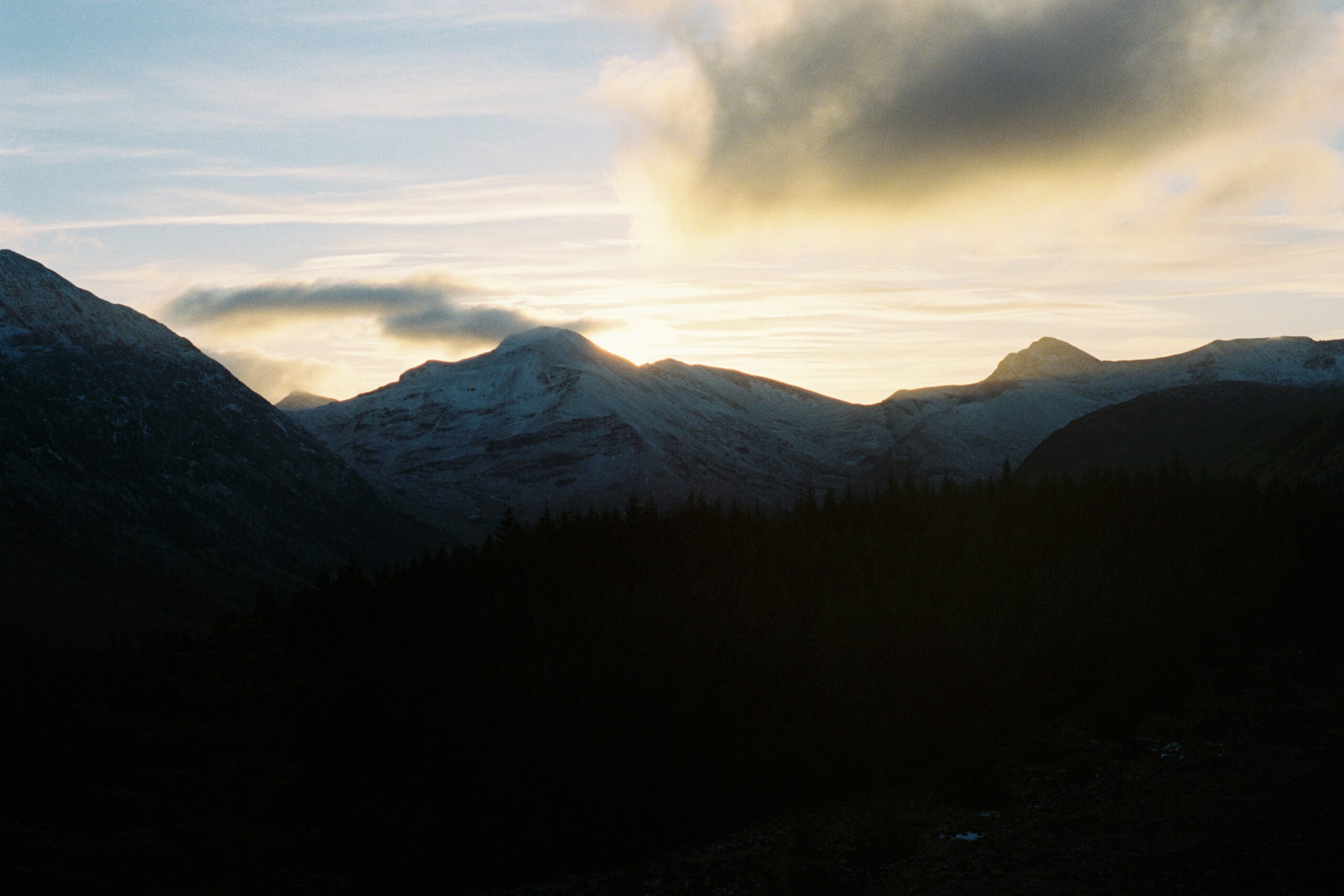
I am the first to arrive at the hut – the rest is traveling on the minibus. After getting the gas, warm water and electricity up and running, I enjoy the silence, wandering around the meadows in the evening sun. The hut I heat up for the rest with a crackling fire. I am enjoying my fire so much that I forget to look outside after sunset, where a lunar eclipse is taking place.

It is late when there is a loud knocking on the door. I open and a group of bouncing teenagers jumps in, and with them a pile of caving kit. Immediately they sprint upstairs, dirty boots and all, to claim the best bunkbeds. Ah, the freshers!
The club has had a bumpier journey than me. It’s Sunday (unusual for a caving trip) and everyone forgot that on Sunday English supermarkets close at 4. So the shopping for 10 people had to be done at a ministore. For now we at least have breakfast, and far too little booze.
The minibus has stranded at the bottom of the dirt track, so we have to go back and forth a few times to carry all our kit to the hut. The moon, now again a dazzling white, is enormous.
That night I sit with a wide grin on my face. How I’ve missed this energy – the pizza-in-a-pan, tower-of-beer-cans shenanigans. But also…leaning back in the armchair, silent sodukus and poetry, browsing through old cave surveys with eyes gleaming.
Ogof Hesp Alyn
North Wales is a different trip than others, because a large portion of the caves here are in fact not caves, but mines.
Mines come with their own challenges and curiosities. Where caves have been formed by millions of years of dissolution, mines exist only because of the brute force of man. Therefore, the stability that a cave has, a mine lacks entirely. A gust of wind can be enough to make him tremble, and nature reclaims her place.
The mines we’ll save for tomorrow, first we’ll go for the caves. The choice is between a simple cave and a very muddy cave. Mud cave it is for me!
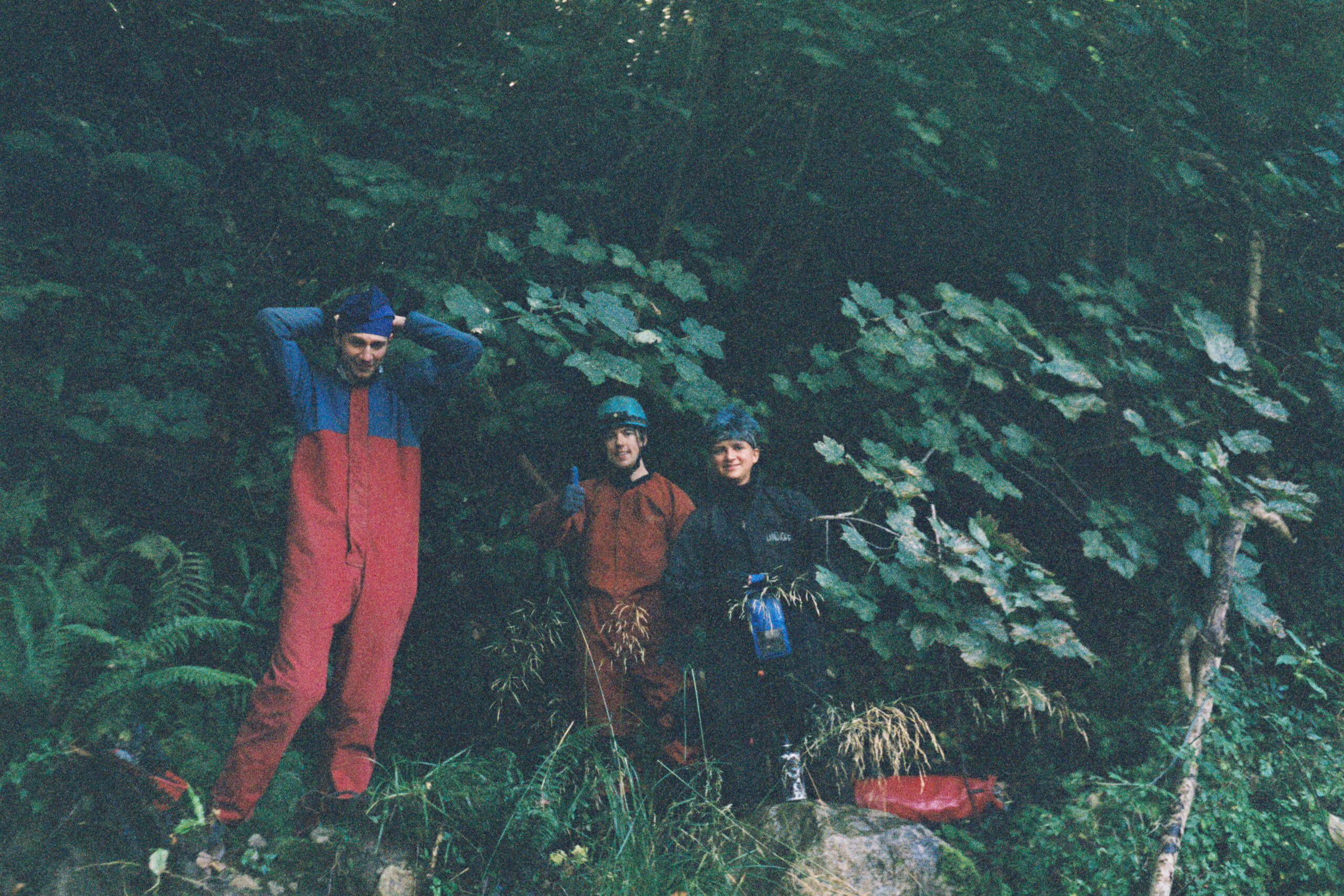
Beyond the Clwydian Range lies Ogof Hesp Alyn ('Dry Alyn Cave') on the banks of the picturesque Alyn Gorge. A brief search on the dry river bed and we find the entrance shaft hidden in the bushes. The delegates today are Attis, Andrew, Witek and me. The rest of the group is going into Ogof Hen Ffynnonau ('Poacher’s Cave') in the same gorge.
Believe it or not, that mud cave is the biggest struggle I’ve ever had in a cave. Funnily enough it’s not the mud that does it (the drought has turned it into clay), but the incredibly awkward climbs that I have to tackle from impossible angles. I am rusty – the first climb is enough to wear me out, and after that it’s a hopeless battle against acidification. I am sweating so much that I gladly jump into the ice bath we find deeper inside the cave.
It is great fun though – some lovely nasty crawls, and fascinating circular features on the roofs that resemble sulfur springs. We don’t know what they are, but they have, in true caving fashion, something celestial.

When we reach the surface, John is waiting for us at the entrance shaft. The other group reached the end of Poacher’s Cave within 20 minutes (but they found an alternative route to a lower level of the cave). A very different day than ours!
But that’s not the last of the caves today. Tony and Tony from the North Wales Caving Club have offered to take us down Minera Quarry (part mine, part cave), which only the club holds a permit for due to delicate formations in the cave. I’ve had my fair share of caving today, so I offer to accompany Daniel to the supermarket, so we can feed the hungry cavers tonight.
'Call-out time?' One of the Tony’s shrugs.
'A couple of hours will do, I think.'
After a little nudge we manage to extract a more specific time from Tony, but how serious we should take it we don't know. Even so we do a very efficient shopping spree and are back well before the agreed upon call-out time.
But at 21:30 there is no sign of life from the dark forest. Nor at 22:00. Who do arrive are three ladies, who park their car right in front of the gate to the quarry and, after looking around lost for a while, make their way into the forest. God knows what they’re getting up to there. Daniel and I imagine them bumping into ten muddy cavers emerging from the darkness. You gotta do something to pass the time.
But a little later it’s only the women who reappear, and when they leave the parking lot (after shining their headlights at our bus looking as though they’ve seen a ghost) Daniel and I can go back to complaining about how long our friends are taking. But really we’re just jealous.
At some point we start wondering if we should call cave rescue. But Tony and Tony are incredibly experienced cavers, so we give them a little longer. And yes, when the cavers return safely at last, we are greeted with a casual ‘we got sidetracked’.
Chop chop, out of caving kit and into dry clothes. We thank the Tony’s and then we rush home, rattling with hunger.

At 1 a.m. we’re finally around the table with a steaming bowl of curry. That’s how it goes on caving trips. Night becomes day and day becomes night – time doesn’t exist underground.
I crawl into bed soon after; Ogof Hesp Alyn has shattered me, so much that I’m not even sure I can make it underground tomorrow. But I’m going anyways, because then we're doing what we all came here for: the mine with the boat.
Croesor Rhosydd
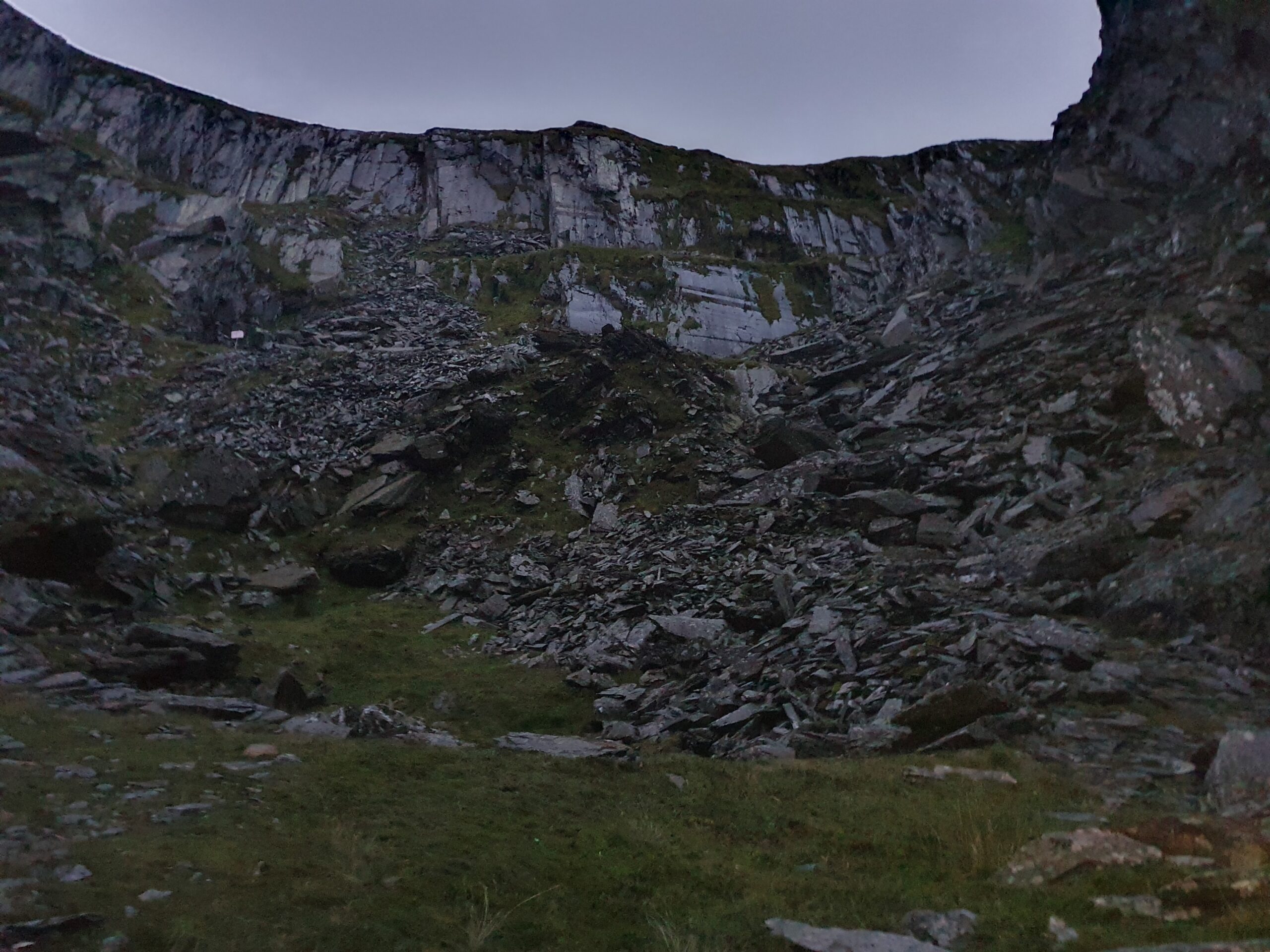
Since Roman times, slate has been mined in northwest Wales. During the Industrial Revolution, the region was the largest producer of slate in the world. Grey villages tucked between quarries, the mountains of Snowdonia hidden from view by slopes of slate waste. They’re an impressive sight, but there's something sad about them too.
Today it’s not miners, but tourists who flock to Blaenau Ffestiniog. In a steam train they follow the same route that brought wagons loaded with slate to the port of Porthmadog.

In Ffestiniog, dinas y llechi ('slate city'), slate was not extracted aboveground in quarries, but belowground in mines. And that’s why we’re here.
The town is surrounded on all sides by mines, but the two we’re visiting are remoter, in the Moelwynion hills. Rhosydd and Croesor are connected to each other by an underground cable tram. We will follow the route of the old railway through the system.
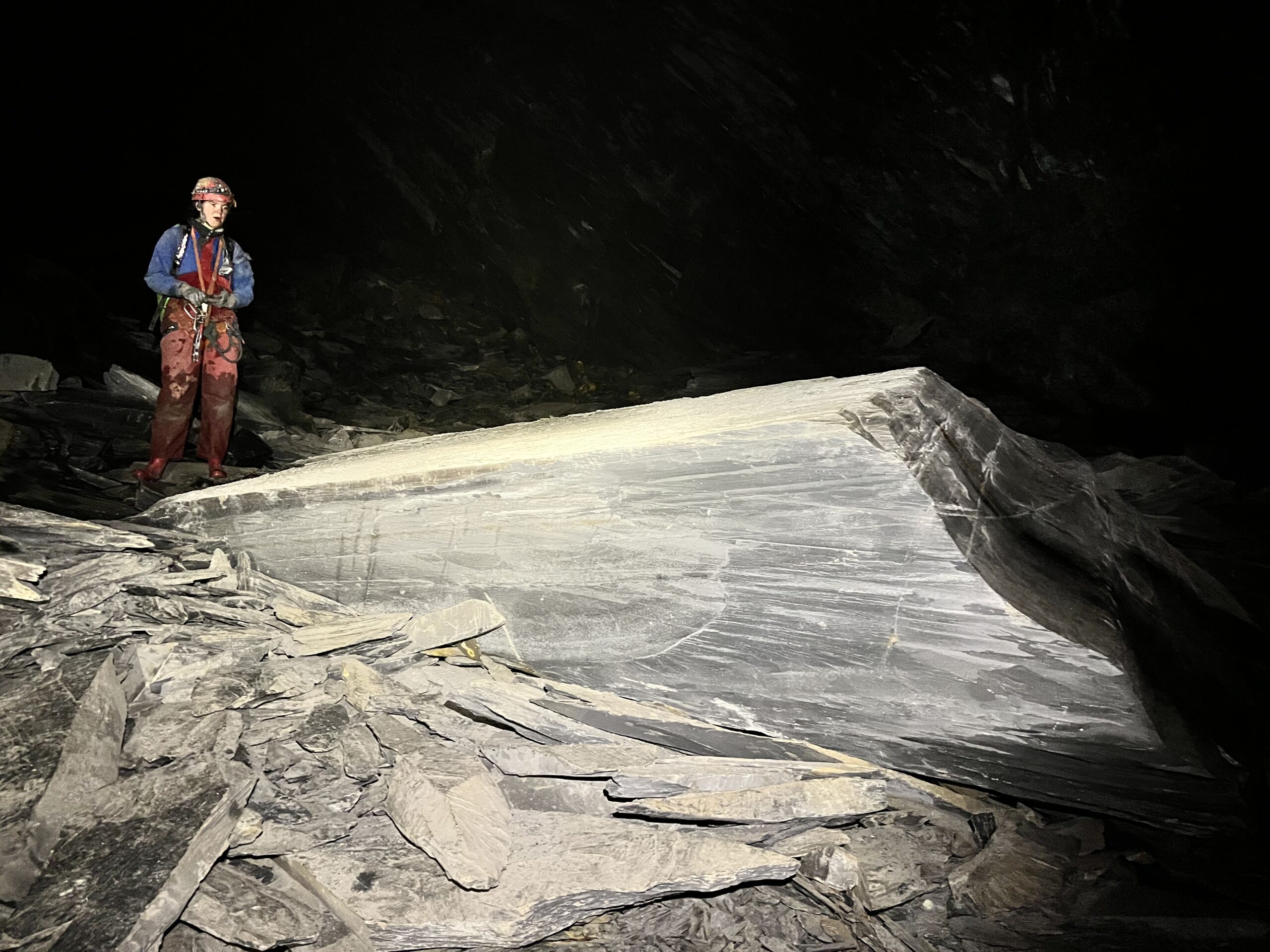
Yesterday we asked Tony and Tony what's the scariest cave they’d been to. The mine with the boat, they answered. This was mostly thanks to a slab of slate the size of a bus that fell down from the ceiling two meters from their heads.
With that image in mind we start the climb. To reach Croesor-Rhosydd we need to hike 4 km through the hills, lugging kilos of rope, in a warm caving suit that is not meant for hiking. It’s always the hardest part of a day caving. At least there is plenty to look at along the way; the landscape is scattered with remains of the mining days: a church, barracks and mills, planted in the dramatic hills of Snowdonia. They are beasts of men, those who built something so grand in this boggy highland.
The mining complex consists of 170 chambers, hollowed out across 14 levels, starting at level 0, and counting up the deeper you go. A couple of shafts are connected to the outside world. The lowest is at level 9. Today, everything below this level is flooded.
We enter the mine on the Croesor side. Walking through the adit, we soon see lights in the distance; they are of two cave divers, who are about to dive a flooded chamber. It makes us dream of passages even darker, even deeper, that even our eyes cannot reach.
We climb up one level and stumble upon the first chamber. One after another we step forward to shine our torch into the black hole. The light barely reaches across, that’s how vast the chamber is. The water is a lucid blue and bottomless so deep.
The scale of the mine is almost impossible to grasp, chamber after chamber whose end you cannot see. And that goes on and on, hundred of meters into the surface.
A little further on is the first pitch we need to descend down. It is said that you can make the chamber collapse with your voice, that’s why it’s called the Chamber of Whispers. Beforehand, I didn’t take this too seriously; what can a voice do against these mighty structures? But now that I’m standing here, I get it. It is an amphitheater, where your voice has the power of a choir, echoed infinitely between the sheets of slate.
Photos: Attis Fielden and Piper Cusmano
The pitch is about 25 meters deep; not an unusual depth for a caver, and yet it feels awfully exposed, to descend this cathedral of slate. When even Daniel shows a glimpse of nerve, I wonder if I should be worried. It’s less than a day since I completely forgot how to do SRT.
But it is mostly the darkness that intimidates: when I peer over the edge and see the bottom of the pitch, I am reassured; it may be slate instead of limestone, but the depth is no different than Rana Hole or Sell Gill.
Besides, the rope is so stiff that I couldn’t go too fast even if I tried to. There is something meditative about descending in silence, the only sound that of my feet gently tapping the slate.
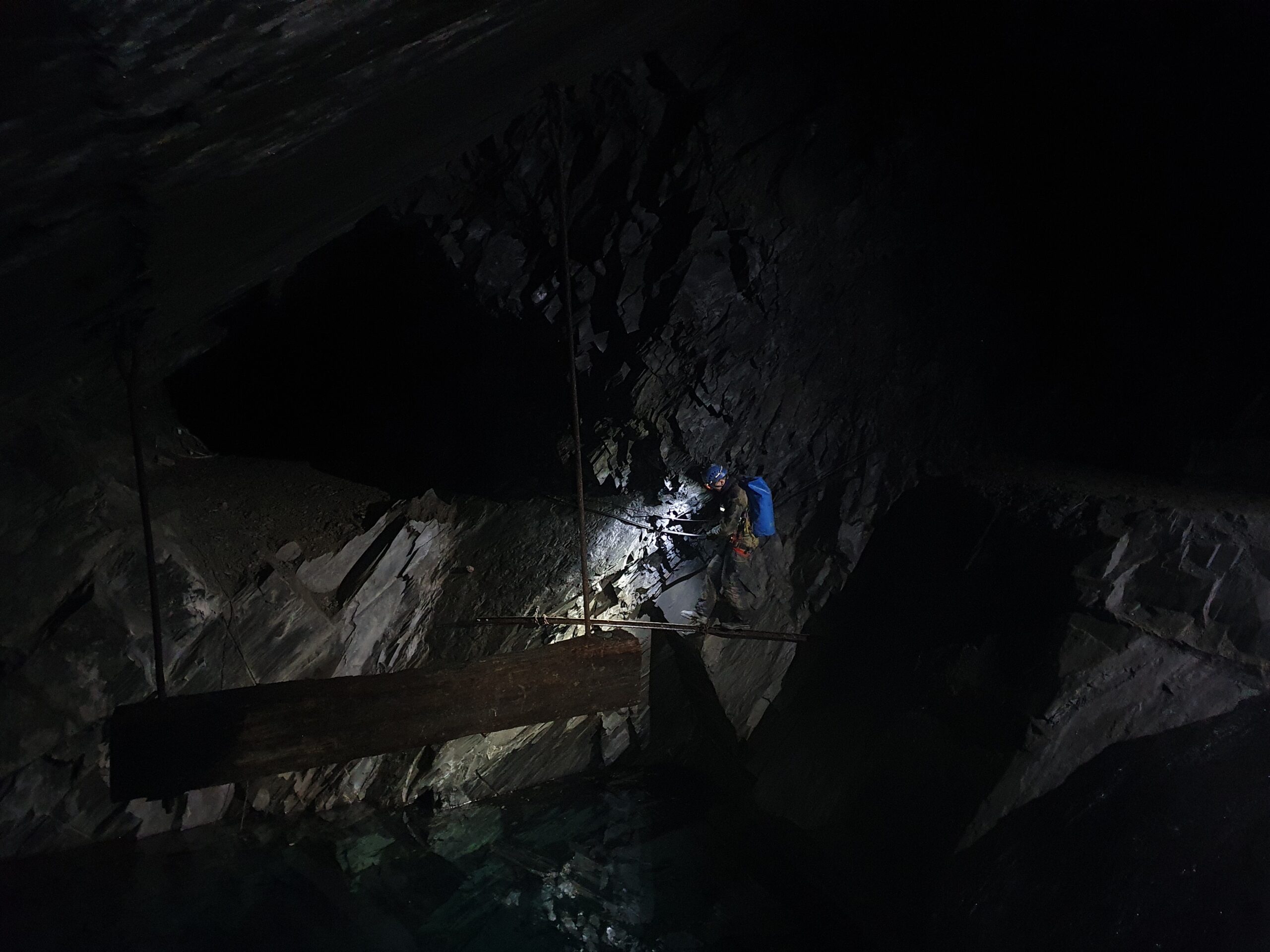
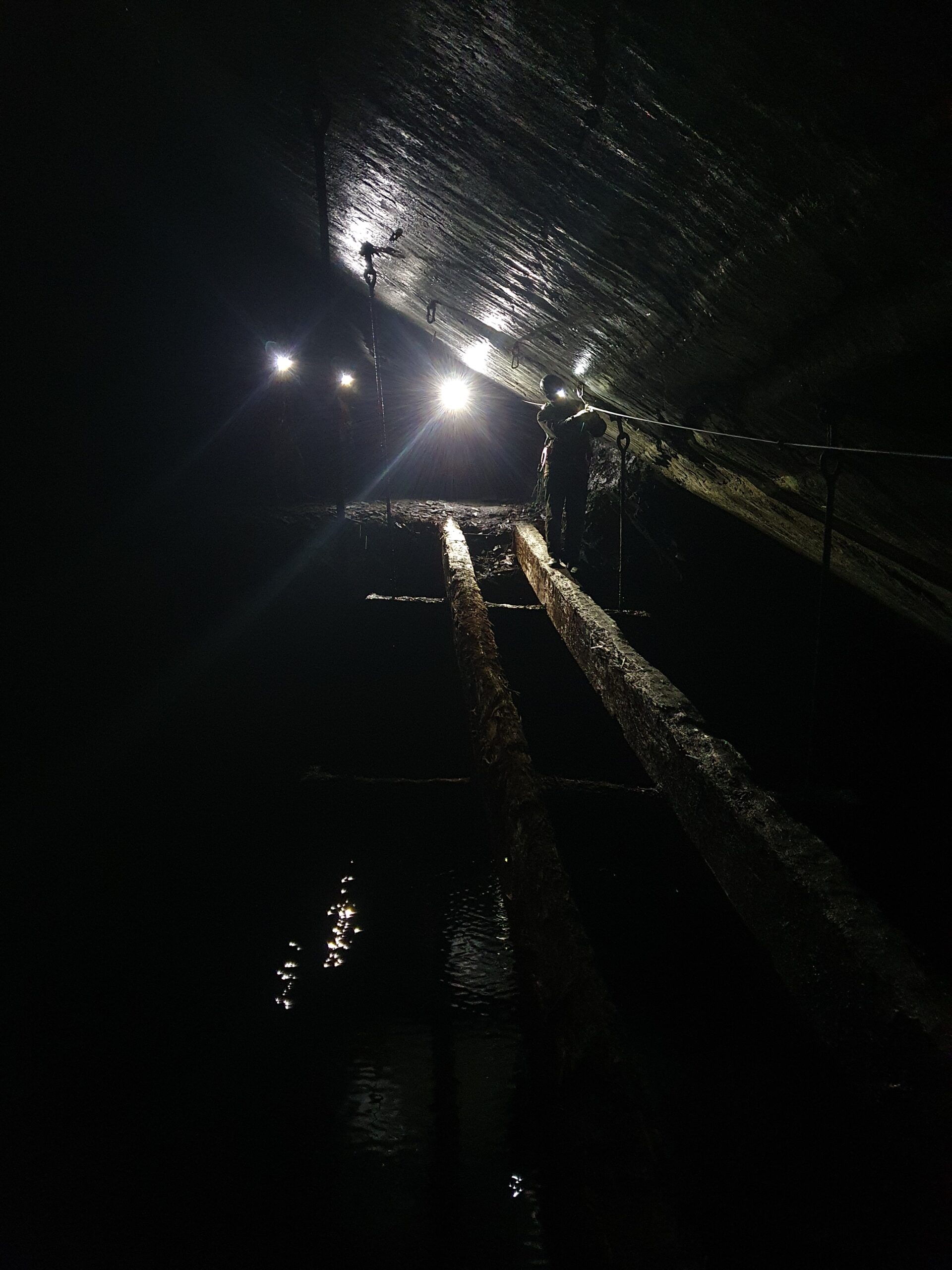
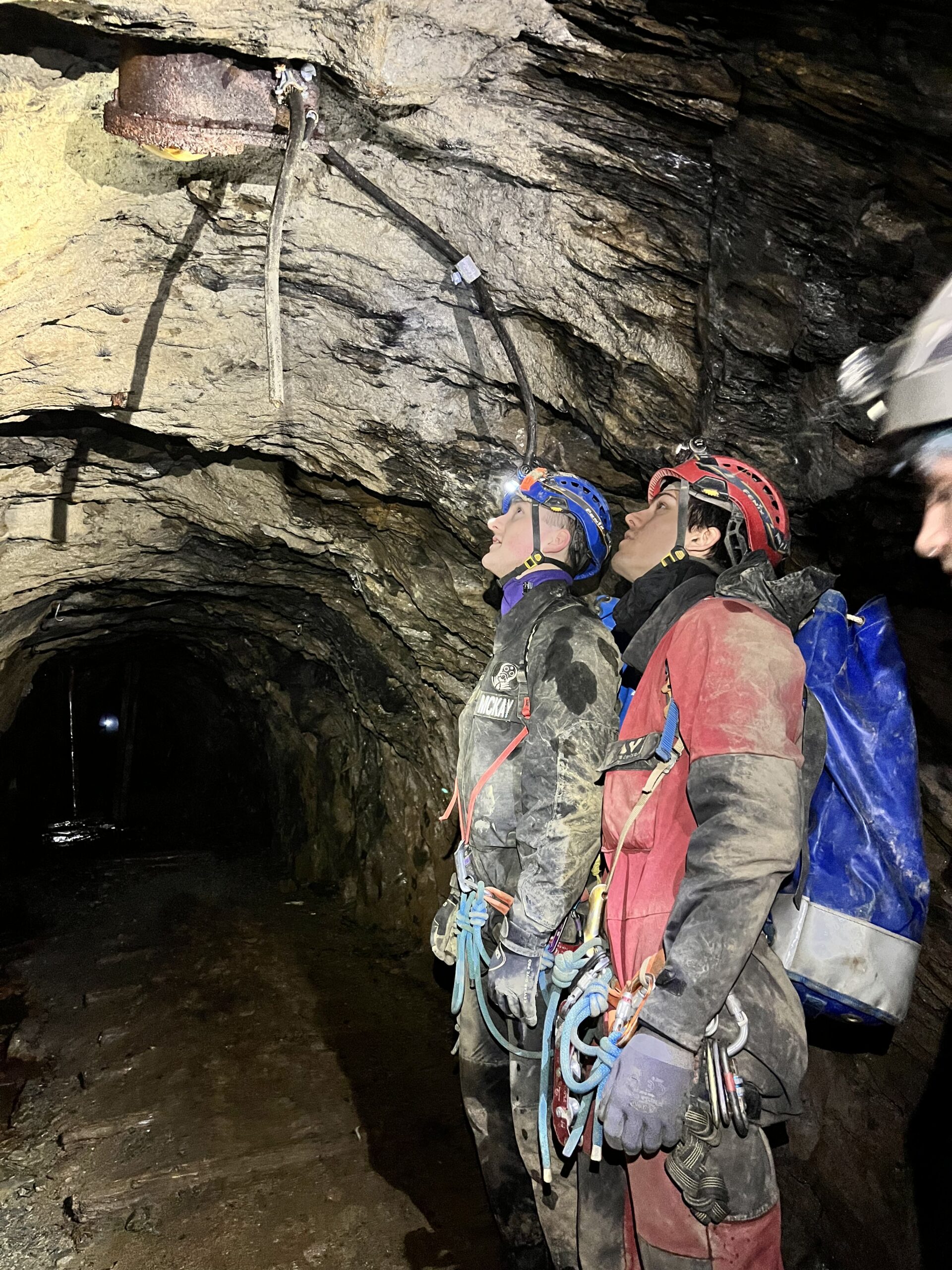
We keep whispering till the next pitch, where a rusty old carabiner is the biggest obstacle. The mine remains intact and beyond it we enter the real playing field. A parcours of ladders, wire bridges, and a zipline, which we traverse over fluorescent lakes. Sometimes we follow the rotten beams of the railway, then we climb walls on rungs; sometimes we are high up in the air and sometimes we touch the water. We’ve never had so much fun in a cave (or mine) for so little effort.
Then the moment suprême: the 'Chamber of Horrors', where a canoe awaits us. The canoe is our vessel to get across the lake. It is attached to the wall with a pulley system, which you can use to retrieve the boat from the other side of the lake. You’re supposed to abseil directly into the canoe from a low cliff. John has the honour of descending first and boiling water out of the boat.
It must have been a while since the boat was last used, for it is swamped. Attis, Piper, Daniel and I take turns to crouch down by the edge of the cliff and watch John's labor.
When the boat is finally empty, one by one we lower ourselves into it, gently, so the boat doesn’t capsize. Piper and John make the first crossing together. Next is Daniel (who is all too happy with a solo canoe trip), and last are Attis and me. By far the most unpleasant thing about this mine is the cold breeze we feel while waiting, and that says a lot about the trip. Once we are safely inside the boat, buoyancy aids on, it’s a smooth paddle across. Paddling through a magic blue underground lake. What more could you want as a caver?
After this we enter Rhosydd, and all that’s left is to find the exit.
The Croesor-Rhosydd complex is the most rescued underground location in North Wales. This is mainly due to people getting lost in the mine labyrinth on the way out. For this reason multiple route description have been hung up in Rhosydd, in an attempt to prevent some lost souls. The route is so rubbed in our faces now that frankly it’d be hard to get lost.
We climb up until daylight shines in, and then back into the abyss, down the slope of a cable tram. We pass by turntables and a slab of slate the size of… a bus? We walk through a tunnel so long we must have crossed an entire mountain. Each passage has infinite turns with an infinite amount of chambers. And in each of those dark chambers a human life has taken place. A lifetime drilling holes into the earth.
Would they ever have seen daylight again? Or did they stay here forever, swallowed up in their own creation?
A cave is the earth untouched. A mine is an earthly simulation. Here, in this hollowed-out space in the ground, we see men’s resolve to bend the earth to his will.
But one day Rhosydd shall collapse. And maybe then we’ll remember that the earth always has the final say.

Leave a Reply