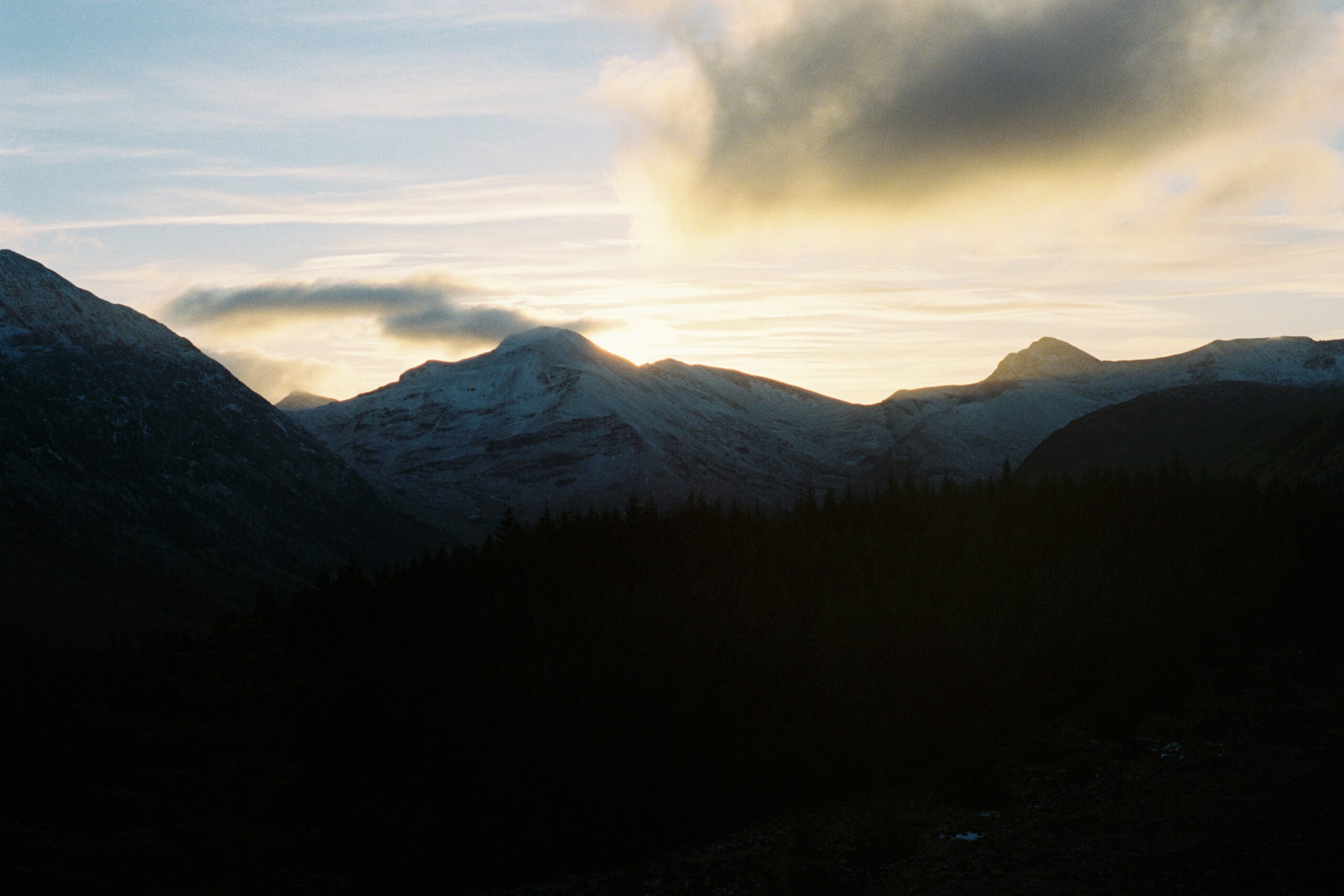
During my time in Scotland I discovered a love for embracing the cold. Wild swimming in Scotland is amazingly diverse, with everything from calm lochs to outstretched beaches to pools beneath a thundering waterfall. If you’ve ever wondered whether wild swimming is for you, then this is the place to try it. There are so many stretches of clear water, even close to the cities. And with dramatic backdrops like these, you’ll never want to do without again.
Below I recount each of the spots where I plunged into the water, with directions & things to consider before deciding to swim there. I am living proof that you can do it anywhere at any time of year, if only you put your mind to it!
Click the link below to view all locations on a map:
My wild swimming spots
1. Camas nan Geall, Ardnamurchan

It was a sun-drenched morning in late February. I stepped out the van overlooking a crescent-shaped bay. The clear sky held the reminder of the spectacle that had taken place the night before. As Liam and I had sat outside in our camp chairs to watch the stars, a faint line of green had appeared on the northern horizon, in an opening between the hills. Aurora borealis. I hadn’t dared dream to see her again.
The sun had started burning stronger this month, and the thought of a dip underwater seemed like a welcome cooldown. I took the boggy path down to the beach, which the Gaels have named Camas nan Geall, or “Bay of the Strangers”. An apt name, for it shelters a cairn and standing stone going back as far as the Stone Age. I undressed and gave in to the pull of the water. The heat of the sun had quelled every trace of cold. There was not a soul in sight, just me & the shadows of the gods that had once ruled this place. This is wild swimming in Scotland.

Directions:
Camas nan Geall lies on the rocky peninsula of Ardnamurchan. There’s an exceptionally remote feeling to this place, where there’s but a few settlements and you have free play over a volcanic caldera and dozens of white-sand bays. Not many people venture to this part of the west coast, although it can be reached within 2 hours from Fort William.
To get here, take the A830 west from Fort William, passing by Glenfinnan. At Lochailort, turn left for Salen. Salen can also be reached by driving south from Fort William, taking the Corran Ferry across Loch Linnhe, and following the road west from here. From Salen, take the B807 southwest onto the peninsula. Drive with care; this is a winding, single-track road with bad visibility. After about 25 minutes you will reach the car park looking out over the bay.
Sadly this location is not accessible by public transport. The nearest bus stop is Glenbeg, a 45 min walk away over the above-mentioned, hazardous road; I wouldn’t recommend trying this.

2. Falls of Falloch

A big pool adorned by a powerful waterfall; crags and lush vegetation on all sides: the Falls of Falloch are a most romantic setting for a swim. There’s the bellowing sound of water hitting water. Waves glistening in the sun, a rainbow gleaming through the steam. Two girls jumping off a cliff & a dog hopping over the rocks, panting happily. On the first summerly day of the season, swimming here was an abundance to the senses.
Take care climbing down the slippery rocks to get to the water. The pool itself is rocky underfoot so it’s pleasant to swim a bit further out to where the water is deeper. There is plenty of space to explore and float around. Water is deep enough to jump in from the cliffside to the right of the waterfall (as seen from the viewpoint), however it’s a rough & steep climb up the cliff, very bushy and rocky underfoot.
Directions:
Located just off the A82 to the north of Loch Lomond, this is a very convenient stopover on a roadtrip around the Highlands. From the car park it’s just a couple hundred meters walk down to the Falls.

Getting to the Falls by public transport is possible, but a bigger undertaking. Take the bus to Inverarnan from Glasgow, getting off at the Drovers Inn. Walk north alongside the road until you reach a bridge crossing over the River Falloch. The road leads to Beinglas Campsite, located on the West Highland Way; you’ll see lots of hikers here, sitting down for a beer next to their big rucksacks. Behind the campsite, turn left to get onto the WHW. You’ll follow the trail for about half an hour, passing between the lovely hills of Breadalbane. The WHW itself climbs up well above the river, the Falls only vaguely noticeable in the distance between the trees. To get to the viewpoint looking out over the waterfall, you’ll need to cross the river. Do not do this when the river's in spate! When the water level is normal, the easiest place to cross is about 300 meters downstream from the waterfall. There’s a faint track leading down to the river here. Take care: it’s a steep slope with high vegetation, but footsteps have cleared the way. Down by the shore there are big rocks to climb on from which you can get into the water. Just before the river narrows to drop down, there’s a wider stream where the current is calm; this is the best spot for the traverse. The water is about waist-deep, so easiest is to put on your bathing suit here and leave your stuff on the shore. I highly recommend bringing water shoes; they ease the crossing and you can keep them on to walk to the falls. On the other shore there’s a small crag to climb up; bit slippery but tree roots to hold on to. And from here it’s only a short stroll to the Falls!
3. Troon Beach

Troon is one in a sequence of towns on the coast of Ayrshire that has a wide sandy beach perfect for a swim. What these beaches lack in wilderness, they make up for with gorgeous views over the Isle of Arran.
I came to Troon with the Polar Bear Club, Glasgow University’s wild swimming society, on a sunny evening in late September. As dozens of us ran towards the water, splashing, laughing, breathing in the cold air, the low sun embedded everything in the most magical golden light. This was the moment where the wild waters took over my heart. It was that shared experience of braving the ice cold waves, feeling their electrical reaction in our bodies, that did it for me.
Afterwards we were shivering as we put on three warm layers of clothes. We snuggled together by a campfire, whilst the last rays of sun faded behind the sea. Downsight to swimming at sunset is that there’s no warmth in the air to heat you up afterwards. Luckily for me we were in a town today, and a town has warm pubs with warm food. A pizza and a pint was just what was needed to top off the evening.

Directions:
There are multiple car parks around Troon within walking distance of the beach. Troon Station is also located 5 mins away. Trains leave every half hour from Glasgow Central and take 40 minutes.
4. Dubh Loch, Cairngorms

At the height of a heatwave, my friend Lucinda and I decided to go on a hike around the wide Loch Muick in the southern Caingorms. It was mid August, the heather was abloom and the still water reflected the purple hills with perfect symmetry. We couldn’t stand still long to marvel at it; midges were out to get us. Down on the shore, two figures had taken refuge in the water from the heat. We had a while to go until we could do the same; today we were aiming for something further out: the glacial Dubh Loch, high up in the hills, tucked between the granite cliff of Creag an Dubh Loch and famed, black Lochnagar.
We’re sweating like hell as we climb well above Loch Muick. We were prepared for wind & rain in the Scottish Highlands; instead we got 26 degrees and a sunburn. At 600 meters altitude, Dubh Loch starts to appear between the heathered hills, magnificent and blue. Two ptarmigans hurry over our trail, groaning, until they disappear in the bushes. The shore nearest us is marshy & rocky, but on the far end a narrow strip of white bears the promise of sand. We get down to the beach, jumping over big boulders, eager to take off our rugsacks & clothes. The loch reminds us that we are indeed in the Scottish hills; even in the midst of summer its water is frigid as ice. It ends up being more of a wade than a swim, for the water level is low, but I sit down gladly, enclosed by the cold.
We are two of five walkers that head up Dubh Loch that day; this is a perpetually lonely place, and that only adds to its austere beauty.
Directions:
It’s a 2,5 hour hike to get to Dubh Loch from the nearest road. Park your car at Spittal of Glenmuick (£5 for car, £10 for campervan), 9 miles southwest of Ballater. Getting here by public transport isn’t possible.

Walk past the visitor centre and follow the track into the glen. Loch Muick appears soon after. You can follow the path around either side of the loch until you reach Glas allt Shiel, a lodge built by Queen Victoria which now functions as bothy. To the west of the lodge, the path forks. Take the right path that climbs out from the shore of the loch into an upland glen, keeping above the river Allt an Dubh Loch. A clear trail continues for about an hour, gaining elevation gradually and crossing a stream, until Dubh Loch is reached.

For the return route, continue in the same direction you started this morning to make a full loop around Loch Muick. An excellent day out!
5. Dumbrock loch

Arguably the best swimming spot within the reaches of Glasgow, located at the foot of the beautiful Campsie Fells. Dumbrock Loch fills up on summer days, but there are lots of secluded spots between the rocks and trees. Bring a paddle board for some extra fun. At the beginning of June the water was warm enough to bathe in comfortably on a sunny afternoon!
Directions:
5 min walk from Mugdock Country Park Car Park. Do not go into the park but head north across the road and enter the grass field through one of the gates. Paths soon lead to the shores of the loch.
Perhaps more fun is to take the train to Milngavie from Glasgow and walk part of the West Highland Way. Follow signs for Mugdock Country Park Visitors Centre, passing by Mugdock Castle. About an hour’s walk from Milngavie through gorgeous scenery.


6. Fairy Pools, Skye

My first wild swimming spot in Scotland, back in 2019, and a great introduction to wild swimming, with a variety of pools, waterfalls and streams to test your cold buds.
The Fairy Pools are probably the most renown pools in the country and rightfully so: imagine the most aqua-blue of waters flanked by the ragged peaks of the Black Cuillin. It’s nothing short of phemomenal.
Their popularity means you’ll always have company here, which can come to use if you are unsure about the safest places to go into the water. If you want more solitude I recommend getting here around sundown. In summer most crowds are gone by late afternoon, which leaves the pools empty and if lucky tinged with golden hues.


Directions:
At Sligachan, turn onto the A863 for Dunvegan. Near Drynoch turn left, following directions for Glenbrittle. After about 6 miles you’ll reach the Fairy Pools Car Park. Parking lot fills up during the day and costs £6. Come early in the morning or late in the afternoon to avoid the traffic. An alternative is the Glenbrittle Forest Car Park, about 400 meters to the north of here; it is free and in a better state than the official car park, but adds a steep descent to the trailhead to your hike.
You can also reach the Fairy Pools by public transport, taking bus 54 from Portree. It runs three times a day and stops right at the car park.
The first waterfall appears about 20 mins onto the trail. You can head as far into the corrie as you want, until you find a pool to your liking. The trail goes on for about 3 kms until it starts climbing uphill.
7. Guirdil Bay, Rùm

Faraway on the Isle of Rùm, with only tiny Canna and the Hebrides beyond, the giant wall of Bloodstone Hill looms over a distant cove. This is Guirdil Bay, where Guirdil River mouths into shallow pools that make for a quick but freshening plunge. Right at the door of Guirdil Bothy, you can quickly heat up by a fire even in the dead of winter. Spectacular setting, where humans are replaced by herds of red deer and feral goats.
Nearby inlets might be suitable for a longer swim, but I did not attempt this in mid December. Take care & do not try this alone. The seas can get very rough here.
Scour for bloodstone, a red-freckled mineral unique to Rùm, on the beach! And allow time to explore the intricate network of tunnels, sea caves & natural arches on the coastline surrounding the bothy. Mad beautiful place in any weather condition.

Directions:
Being the remotest spot on this list, getting to Guirdil Bay is a challenge & should be combined with staying overnight at Guirdil Bothy or camping on its grounds.
First step is getting on the ferry to Kinloch, crossing over from Mallaig on the mainland. Navigating the ferry timetables is tricky business, especially during winter time when services are reduced and often cancelled due to bad weather.
If you’ve managed to make it to the island, next step is a 3 hour hike from Kinloch. Start by following directions to Kilmory over a well-maintained vehicle track. Stay on this track for about 4 kms until it bends north into Kilmory Glen. Here a rugged path cuts off from the road on your left hand, climbing up into Glen Shellesder. Head up this trail that brings you to the shores of Guirdil Bay after about 5,5 kms. The terrain of Glen Shellesder is rough, with endless bog underfoot. Near Guirdil there are some river crossings, the last of which can be difficult after heavy rainfall; it might be necessary to wade through. There are no facilities, houses or people on this part of the island. So make sure to bring everything you need for a night in the wild, including good boots, waterproofs & fuel. This is not for the faint-hearted!

8. CAMPSIE GLEN


A wonderful hidden spot in the Campsies, and the closest I’ve come to an ice bath in Scotland. My friend Nick and I headed out on a cloudy morning, early February, after having been caught in the rut of the city life for weeks. I was in need of tickling my senses, and what better way than with some freezing river water?
On a muddy trail along Kirk Burn the cloud cover slowly descended down on us, shrouding the glen in a blanket of fog. It only added to the wintery atmosphere. There it was; a waterfall, emptying into a small pool between the overgrown crags. It wasn’t exactly following our instincts to take off our clothes now and scramble over slippery boulders to the water on bare feet. But we did it anyways.
The cold took my breath away and numbed my limbs, but movement is a powerful thing. Every move I made kept the blood pumping to my fingertips, and soon enough my body adjusted to the cold, creating a new hemodynamic state. All of this happened in the course of minutes, and I knew I shouldn’t stay in longer; it’s a fine line between cold kick and hypothermia. But this time I got out of the water and wasn’t shivering as I put my clothes back on. My body recovered quickly; I could feel it getting stronger by the day.
Directions:
Campsie Glen Waterfall Car Park is located along the B822, a 30 minute drive north from Glasgow. From here it’s a quick descent down to the falls over a straightforward trail, that becomes rougher and scrambly near the river bank.
Alternatively, take the X85 to Clachan of Campsie from Glasgow Buchanan. To the right of the tearoom a path leads north into Campsie Glen. At the fork take the right path which climbs gradually above the glen towards the car park, before dropping down again towards the waterfalls.
9. Luss, Loch Lomond

The tiny village of Luss is one of the most beloved stopovers along the banks of Loch Lomond and cannot be forgotten on this list. It has a pier and pebbly beach with great views over to Ben Lomond. Tourists and local families flock here on the weekends, so be ready to have some onlookers as you duck into the water. Nothing beats the thrill of jumping off that pier!
Coach House Coffee Shop provides a warm cup of tea to heat you up afterwards, or if you need more than that, head up the grassy slopes of Beinn Dubh for some magnificent views. Also plenty of opportunity to try out other water sports here.
Directions:
Several buses travelling north from Glasgow over the A82 towards Oban/Fort William pass by Luss. Take care crossing the busy road from the bus stop. There’s a big parking lot here for those travelling by car. Short walk through the village to the waterside.

10. Loch an eilein, Cairngorms

Nestled within the ancient Rothiemurchus Forest in the Northern Caingorms, with an island castle ruin as your backdrop, it is hard to imagine a dreamier place for a swim. I didn’t stay in long, for the water was freezing cold (the extreme wind that day might have played a part), but it was long enough to feel the serenity of this place flow through me.
Loch an Eilein is a popular spot for tourists, and convenient due to its proximity to Aviemore, the gateway to the Cairngorms. I cannot attest for how busy it gets here in summer; I was there on a weekday in February. Even at this time of year there were quite a few walkers, but it was easy enough to find a quiet spot for a swim, just meters away from the trail and with Loch an Eilein castle in sight. Dense vegetation means you are easily sheltered. Be careful not to trip over tree roots on the bank of the lake.
Directions:
Car Park Loch an Eilein is located right next to the shore of the loch, a 10 minute drive from Aviemore. For those coming on foot from Aviemore, turn left on the roundabout at the southern end of town, heading for Rothiemurchus. Walk on the sidewalk until you reach a turn to the right for Kingussie. Stay on the unpaved road for a few meters until you see a gate to your left which leads into Rothiemurchus Forest. This footpath makes for a lovely stroll through the forest, passing by Lochan Mor until you rejoin the road. Turning left, it’s a couple hundred meters walk over the road until you reach Loch an Eilein. This walk takes an hour from Aviemore.

11. Seilebost Beach, Harris

If I must name any place the crown jowel of Scottish beaches, it’s gotta be the Isle of Harris. Even on a cloudy day its waters luminate turquoise hues. Wiggling your toes in the white sand, you almost forget you are this far north. The view over Seilebost sands and the ford of Luskentyre beyond is perhaps the most fantastic of them all, the sharp hills of North Harris an unmistakable presence on the horizon.
It was May when I finally set foot on Harris (after two failed attempts), and by this time Nick and I had become seasoned swimming partners; the sea, however gusty or wild, could not dissuade us. So it was that we plunged into the water on this day, when the wind kept everyone else from even walking the beach, and we were relishing. I didn’t even feel the cold.
I did feel it afterwards, when we were waiting on a hitch and my limbs had not had the chance to heat up. But that’s a small price to pay for a chance to swim in paradise.
Directions:
Seilebost Beach is located on the Atlantic coast of West Harris, a 15 minute drive from Tarbert over the A859. Bus W10 for Rodel stops here on request. We stayed at Horgabost Campsite and walked along the road from there to an amazing viewpoint over the sandbanks. This is safe; the road is quiet and often travelled by those walking or cycling the Hebridean Way.
Don’t be deceived by the proximity of the sandbank across from Seilebost Beach. It may be tempting to try and swim there, but the current is stronger than it seems and you will be worn out long before you reach it. Stay in the shallower waters, and look out for jellyfish!

Leave a Reply