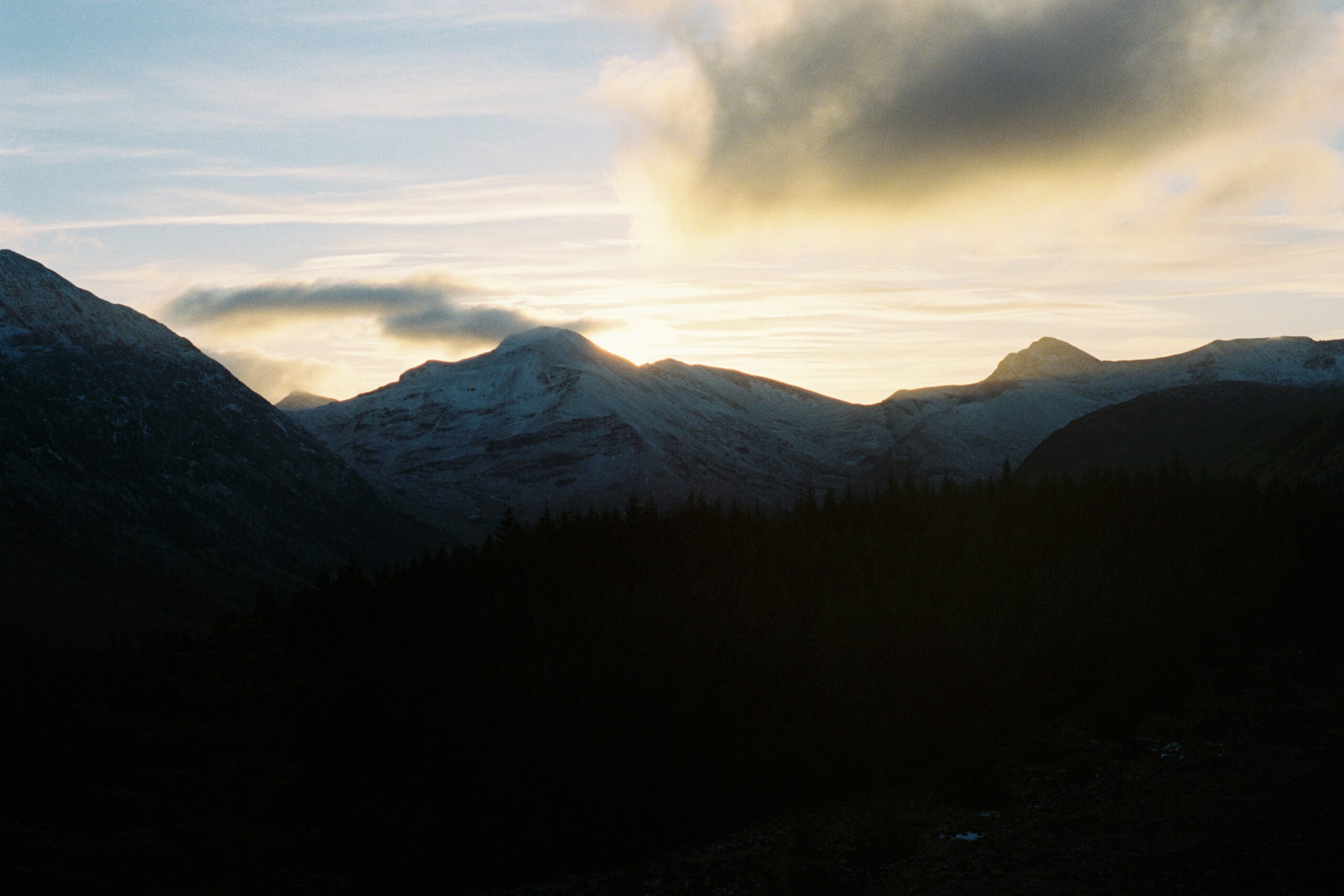

There is a wee hill in Assynt that has won over the hearts of many: Stac Pollaidh, Gaelic for “steep rock by the pool”, a name which describes the hill all too literally. Minimal effort is rewarded with views over Sutherland's wilderness as far as the eye can see. The title of best short hike in Scotland would not be out of place here. But there is a catch: Stac Pollaidh's true summit is a third grade scramble. Today we do an attempt to reach it, but not the same way anyone else would.
Nov 20, 2022
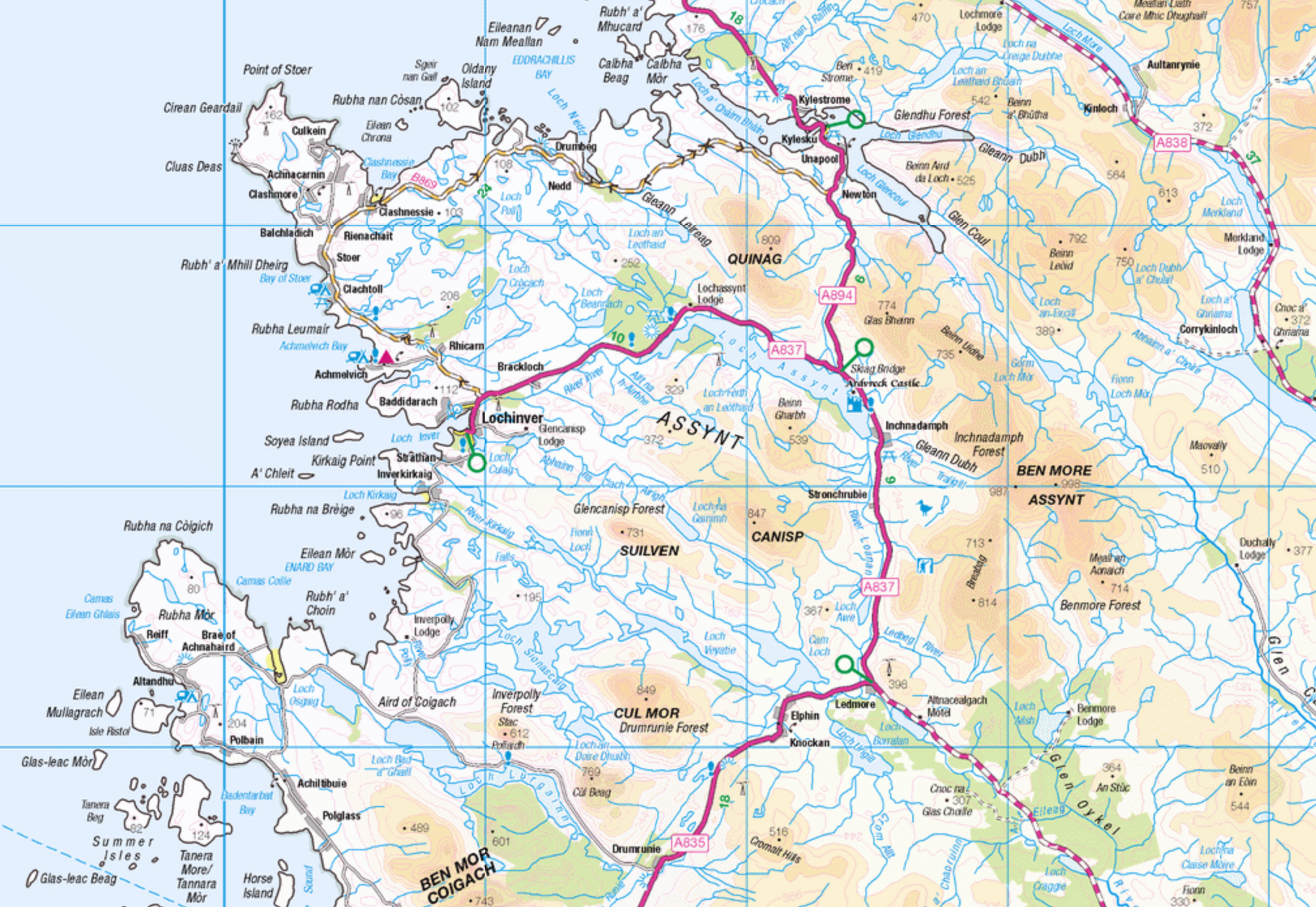
The morning is cold, but the sun, a soft glow on the horizon, is slowly paving its way through the clouds. We drive away from the sea and back to the hills. A turn in the road and the inselbergs of Assynt return, a few peaks just barely shrouded in clouds. But Suilven is out. I feel a pang of regret at sight of this. We have missed our shot. Today is our last day up north. Tonight we drive back to Inverness, where I'll take the bus south to Glasgow; tomorrow I'll be back in the lecture halls.
But then I remember the turbulence in the sky last night, the wind swishing past the van. It hadn’t been a night to sleep on top of a mountain, but one to stay warm underneath the blankets. Suilven has to remain a dream. And I will come back for her.
Besides, there’s a hill on the southern edge of Assynt that is no less alluring. And she too triumphs over the clouds today. Stac Pollaidh (612 m) is wee, but a tough one. A twisty road passes by her southern foot, making it possible to climb the hill in less than two hours. But her true summit is said to be the hardest to reach on the mainland of Britain (in other words: not counting the Cuillins on Skye). It requires a scramble over exposed pinnacles and crags.
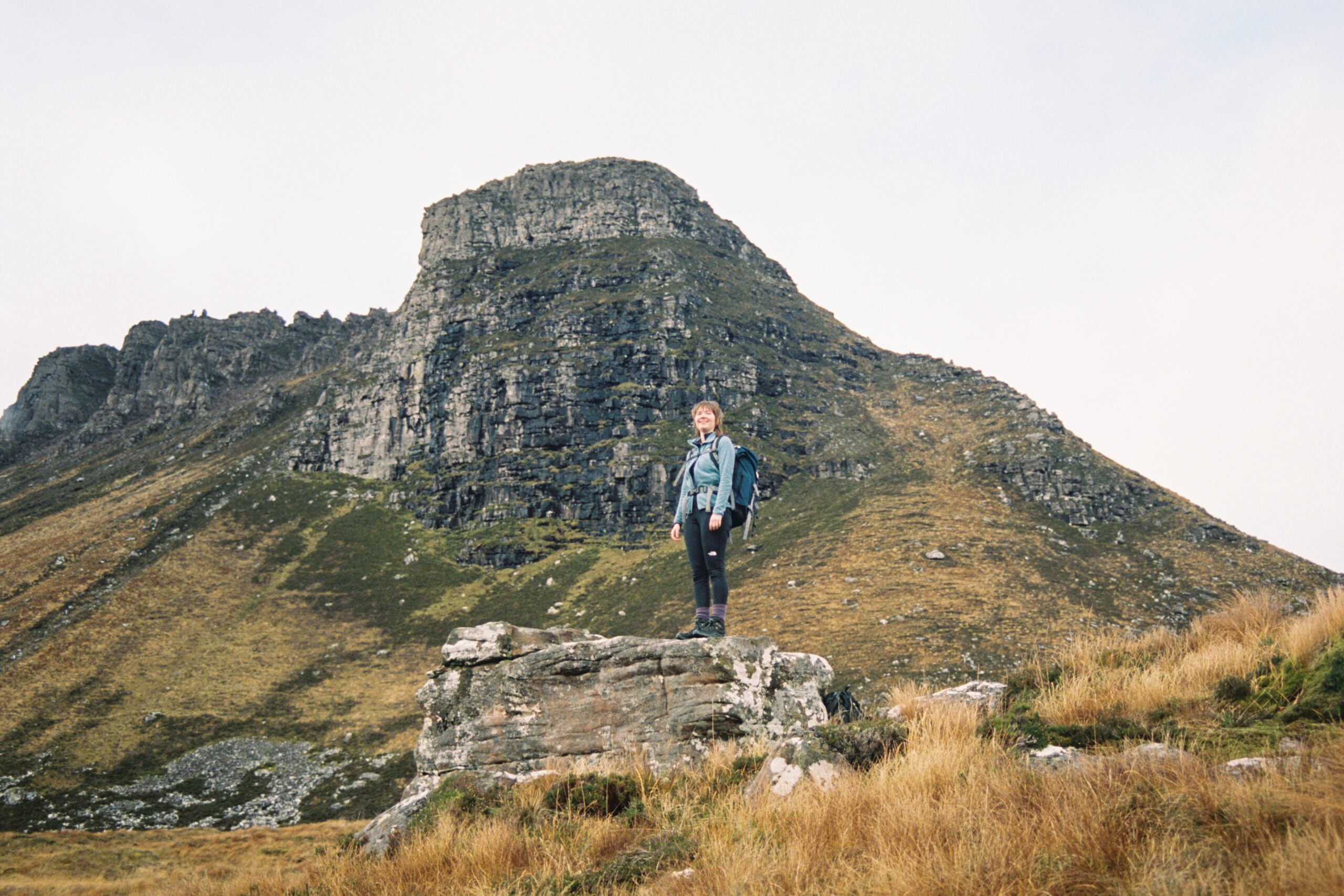
Just like the surrounding hills, Stac Pollaidh has been carved out by glaciers, but the elements have been a bit rougher on her. From a distance it looks as if a giant has taken bites out of her crest. Thousands of human feet trampling the bedrock have sped up the erosion process. A new path has been constructed, wider around the foot of the hill, to protect her fragile rocks. But one day she might crumble so far that her highest peak will be unreachable for men. Perhaps that's for the best.
For the time being, we are the only feet walking Stac Pollaidh today. The trees under the hill have almost lost foliage - their last leaves are the colour of a dark red wine. Soon enough we leave them below us. Every few steps I look back to the hill Sgòrr Tuath, that emerges across from Loch Lurgainn - a view that becomes more brilliant by the minute. The sun is just behind the hills, and the ridgeline lights up in a glowing yellow. There it is again, the magical light of November. The heather turns orange, while grey clouds drained it of colour just moments ago; the shadowed hills are a deep blue. And the water is smooth as glass, there's no ripple to be seen. Time seems to stand still.
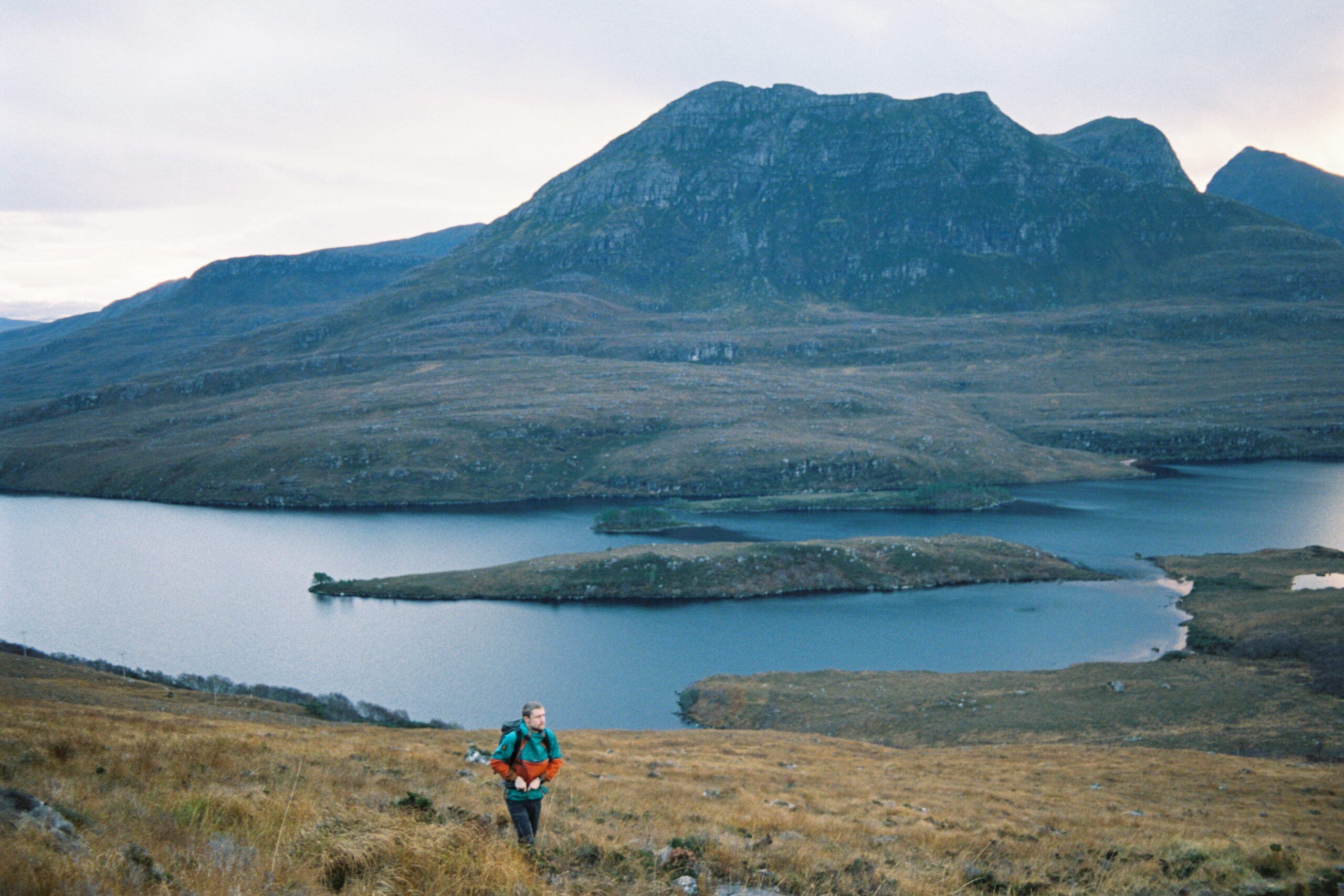
We take in all the corners of the landscape. I open up my senses, I want to imprint all their sensations in my brain. It’s the only time we’ll perceive this place, exactly as it is at this moment. We find a perfect flat rock where we sit down for a sandwich. A family passes by us, all three in the same running outfit, climbing up at a rapid pace. We don’t see them again.
We continue our stroll over the pleasant path, Cùl Beag on our right. Gradually we climb around the east face of Stac Pollaidh, and the rest of Assynt comes into view. First Cùl Mòr and the extensive Loch Sionascaig, then Suilven, the cone of Canisp in the distance between them. From here we see the ridges in their full length, much larger than they appeared from any other angle. At this distance, it seems impossible to reach it, the Grey Castle of Suilven, surrounded on all sides by vertical cliffs. But hills are built to intimidate, it’s a natural illusion.
On the north side of Stac Pollaidh, the path starts climbing more steeply as we approach the ridgeline. It isn't long until we stand on top of the bealach. From an overhang we are able to gaze south past the pinnacles over the hills of Coigach. We are high enough to see the sun shine just above Ben Mor Coigach.
A father appears on the saddle, with two children and a dog. Great day out, eh? Cheerfully he takes a picture of us. Are we going up the true summit too, he asks us. We did not plan for it, we tell him. But secretly we try to find out if it really is as hard as it seems.
It's a good scramble, but his oldest has done it before. With pride he points at his son, who has all but vanished between the crags.
You should hurry though, the sun is setting soon.
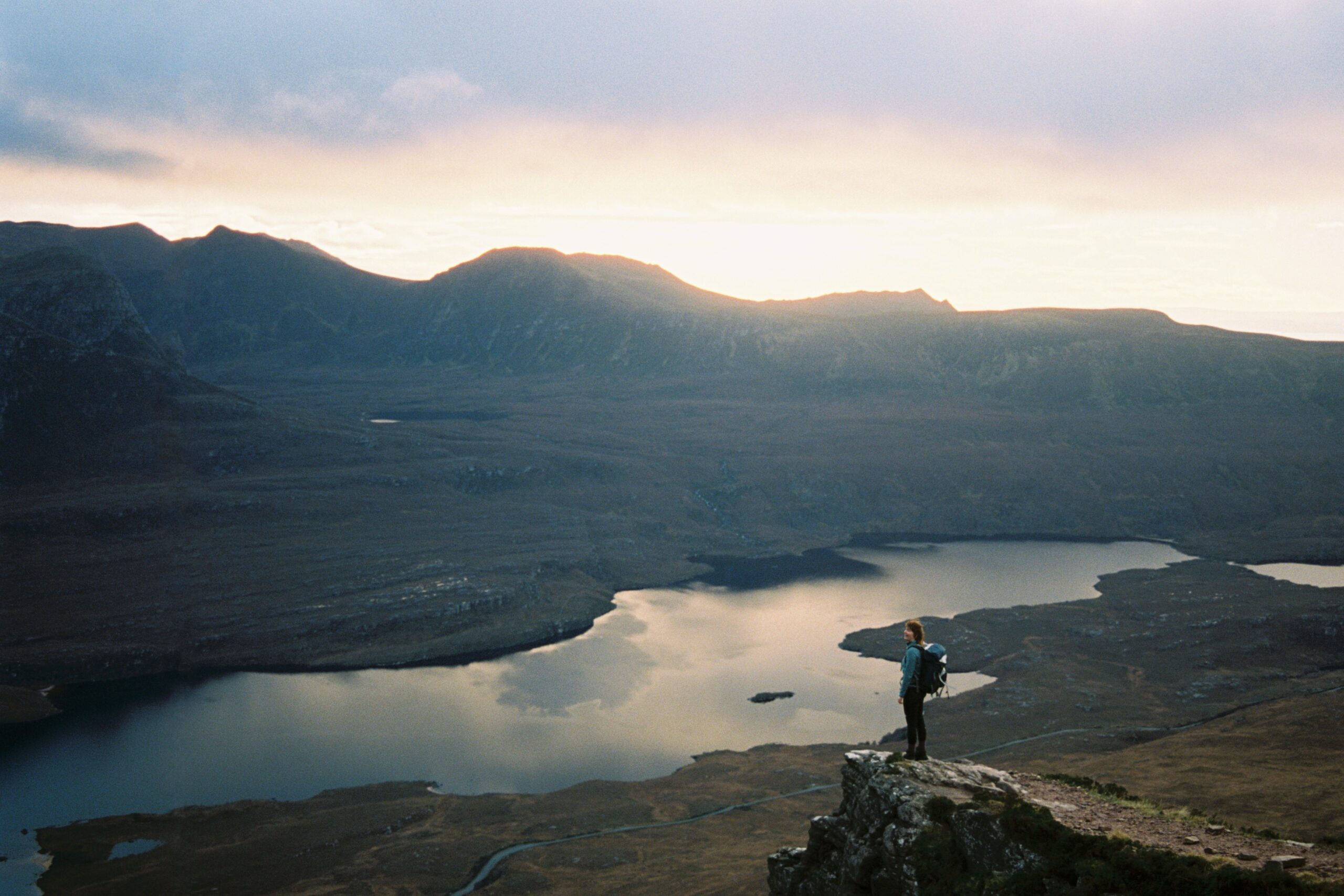
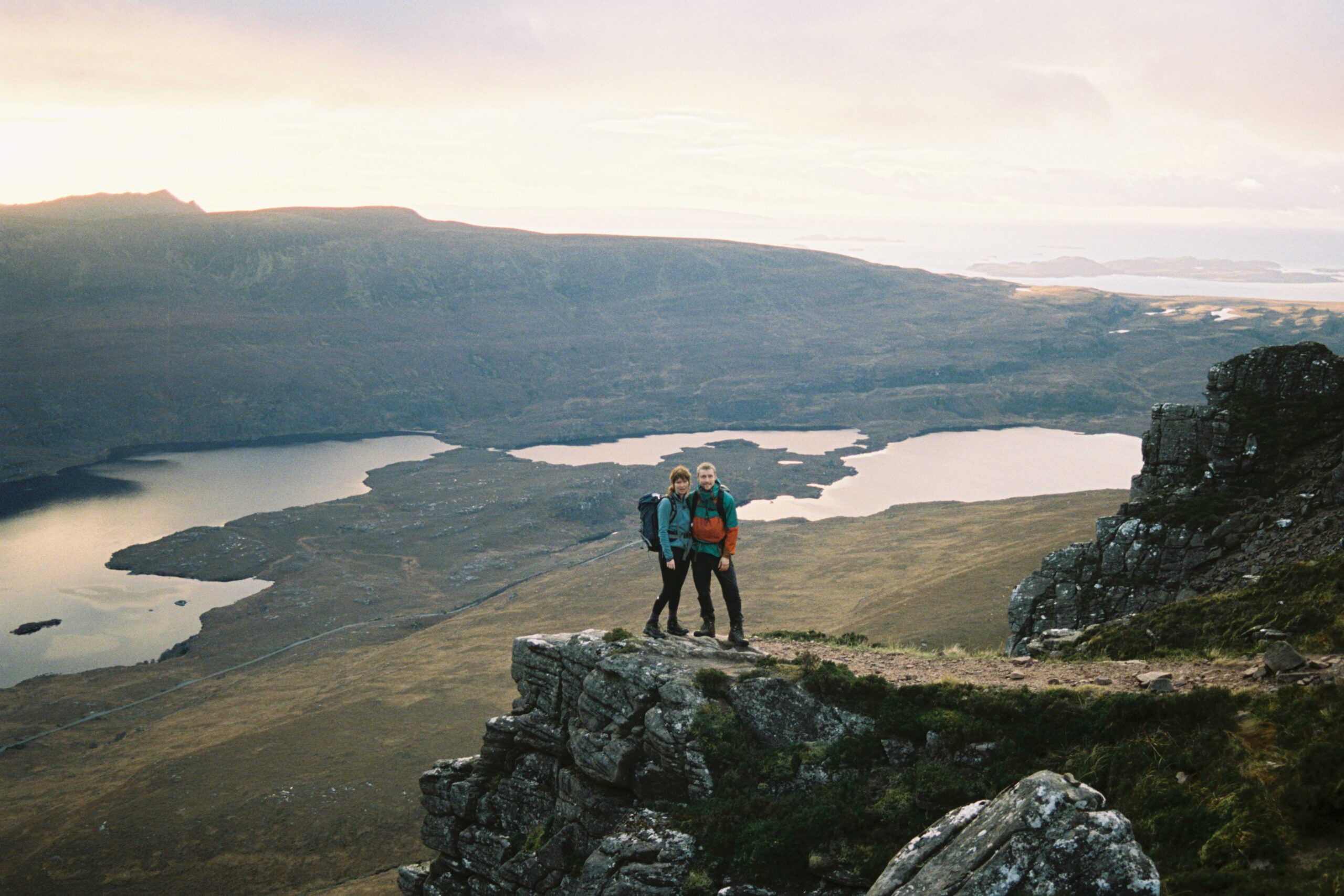
They go west, we go up the eastern summit. An easy scramble – it takes us less than a minute. But the reward is incredible: a panorama, 365 degrees around us. Once again Assynt takes my breath away.
Assynt is a wet place, as much water as it is land. From this height its patchwork of humps and lakes is visible, referred to as knock and lochan in Scots. It can all be traced back to that ice sheet, that eroded the Lewisian gneiss into many round hillocks, alternated with lochans where the bedrock was weaker. All of this is treeless, barren. A similiar relief can be found on Shetland and the Outer Hebrides, and underneath many more former ice sheets on the Northern Hemisphere.
The setting sun emphasizes the autumn colours of the landscape, and it becomes clear to me: I would give all my summer days for a clear winter day in the Highlands. The sun may only rise low in November; when she does show up, she takes her time to subside, resulting in an endless sunset. The harsh summer sun cannot compete with it. Now it's half past 2 and the sun peeks underneath a cumulus. Her beams cast a long strip of light over the moors. A moment later the clouds have lifted, and she has free rein again. And like that, the worlds changes every minute.
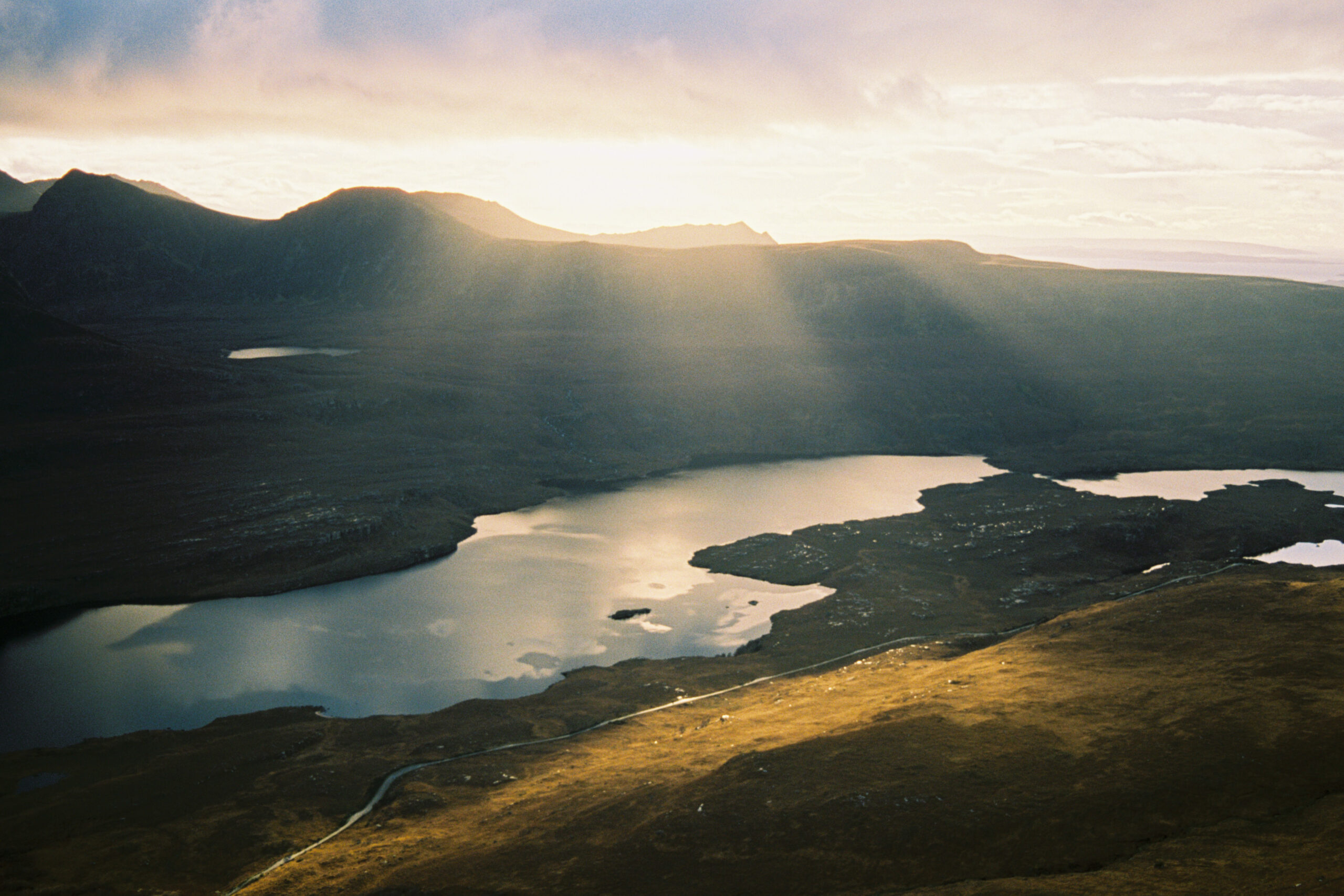
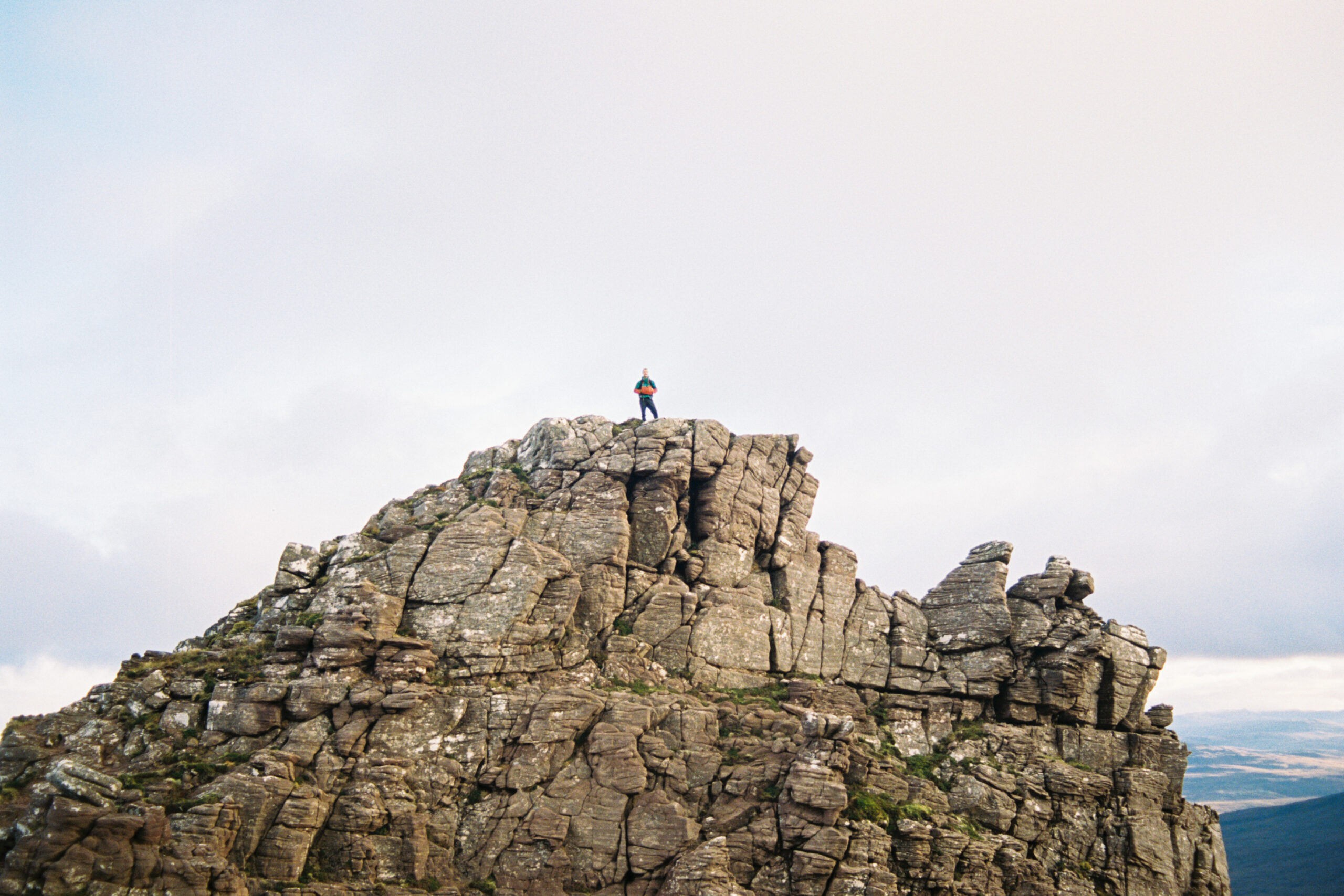
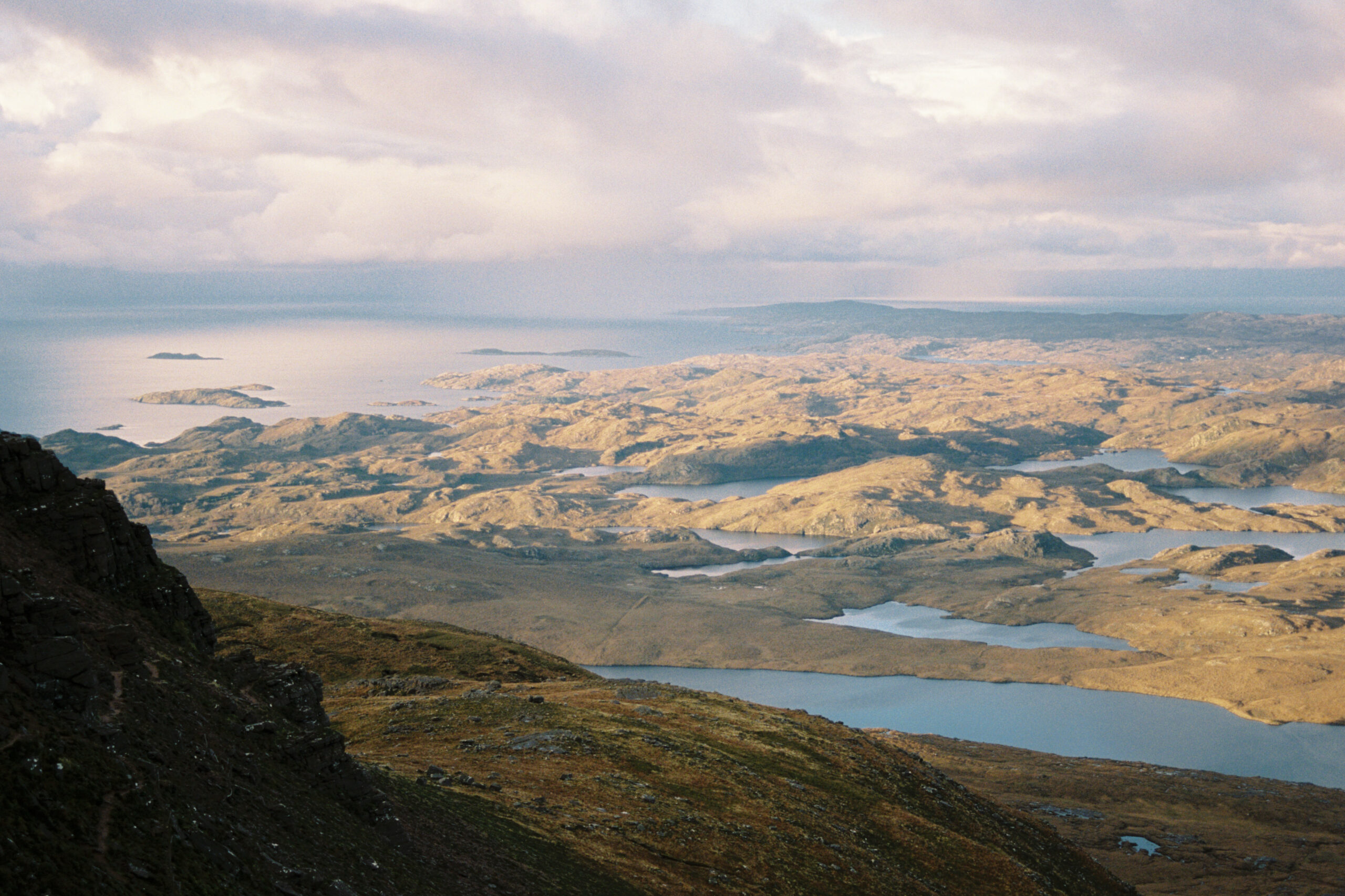
Toward the west we see Stac Pollaidh’s outcrop of Torridonian sandstone, stacked in impossible angles. Beyond, the land dissolves into the sea. There are many isles offshore, perfect to kayak through: the Summer Isles.
Two small heads appear above the rocks, jumping back and forth. They shout and point down, to their dog who is going the wrong way. For him it might be too scary after all.
We are faced with a choice we know all too well: to return to the van and content ourselves with what we have seen, or to go one step further - but wasn't that something we humans should do a little less often?
The sun is with us for another hour, enough to scramble to the top and back. The rest of the trail should be easy to follow in the dark.
But we don’t know the route – we have no idea how to tackle the trickiest sections. Besides, we have a ride to Inverness ahead of us, where the last bus to Glasgow departs at 18:20. In order to catch it we should leave the car park in an hour.
I did not intend to aim for the highest point today, I was only out see that legendary view. I have always known that Scottish scrambles are not to be underestimated, and this summit might be above my league for now. But we are here now, there’s no harm in trying. Many men have made a stab at it, and turned around at sight of the tallest pitch. I tell Liam all of this, but today his good sense has the upper hand.
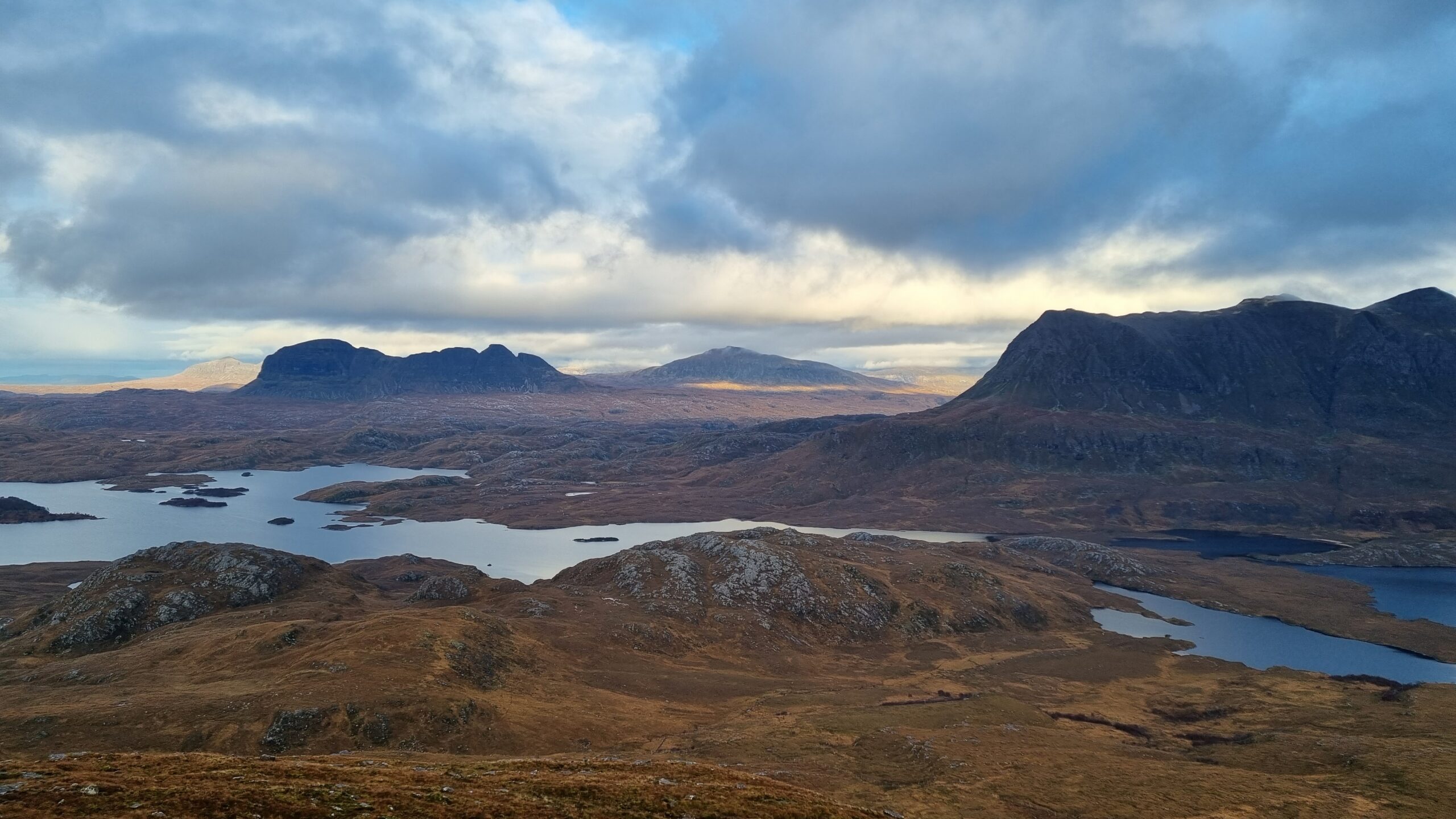
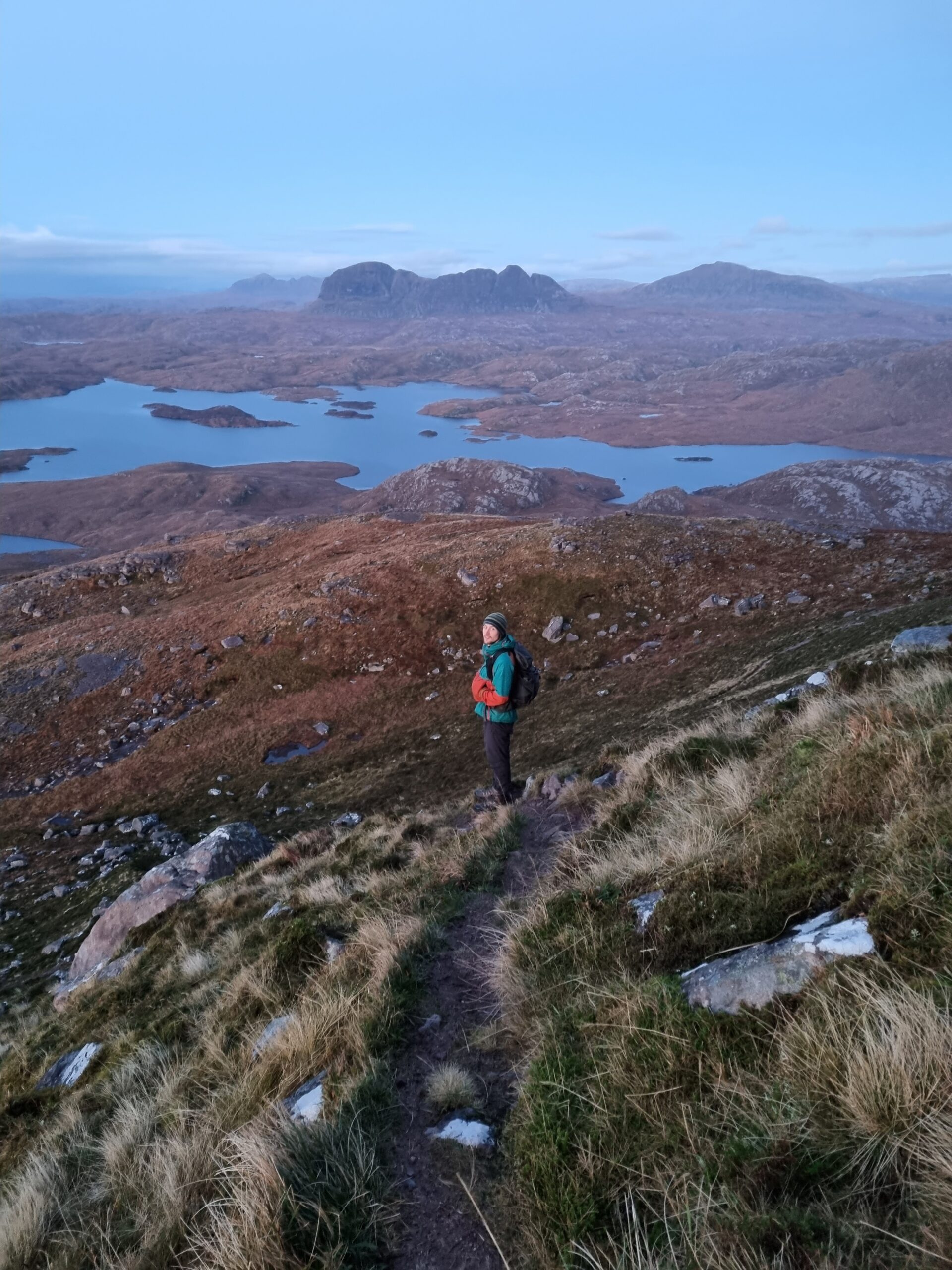
Seems we've got better at it, being satisfied. The bealach lights up from the last horizontal sunbeams. We turn our backs on them and go down the zigzag path. Instantly, we are embraced by the shadows. We dash over the gravel, there’s no wind slowing us down. We have descended quite a bit when Liam stops to gape at the steep slope above us, the western summit of Stac Pollaidh hidden from view. The incline is big enough to see the spectacular ridgeline that it leads to.
He looks at me with those eyes full of dreams. And I know then that he cannot resist it. The pull is too strong.
The lure of the rocks
Ten minutes ago we could have taken on the western ridge from the saddle, and we might have been standing on Stac Pollaidh’s summit at this very moment. Instead we are struggling up a slab, grit and stones coming our way. Liam climbs ahead so I’m not hit by falling rocks. My body acidifies quickly and I grunt out, annoyed at this unnecessary effort. But inside I'm also gleaming. Who can say they climbed Stac Pollaidh from this side?
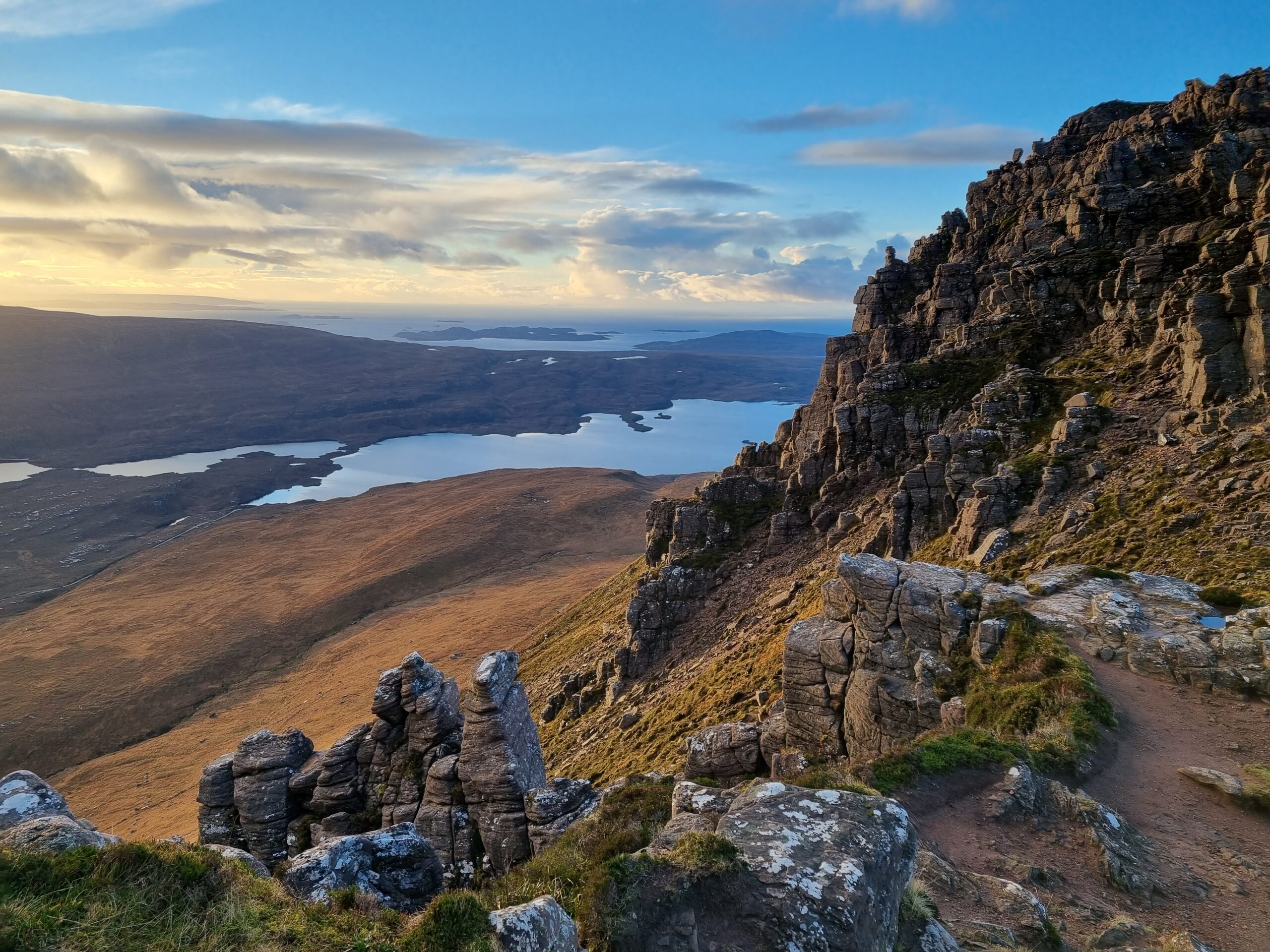
Out of breath I reach the ridgeline, in awe of the vast playground around me. I hope we have bypassed the hardest section of the route with our little detour, but this couldn't be further from the truth. We scramble up and down some pinnacles and maneuver past a deep gully, clinging to the rock face. Then we are faced with the last obstacle that blocks the way to the top: a bulbous tower, at least 6 meters high, flanked on both sides by deep pits.
There’s no way we’re supposed to climb up that. We look for an alternative way to pass by the tower. To the right, the vertical cliff drops straight into a steep gully, impossible to pass, but to the left we are able to descend slightly into the gully till we stumble upon a groove that appears to connect to the ridge above us. To get there we need to climb up a leaning slab and squeeze through a narrow cleft in the rocks, while a precipice gapes at us from below. We don’t know if this is a usual route to the summit, but it offers a lot more shelter than the exposed front of the tower, so we decide it’s our best option. Liam wriggles through the groove. On the other side his head pokes out above the ridge. A passageway! With clammy hands I lift myself up and pin my body between the rock walls. The proximity of the gully below makes it one the scariest scrambles I have done up until that point, but it isn’t an overly technical climb – I know my body is capable of doing it. The biggest challenge is keeping a cool head.
Later, we find out that the vertical pitch we’ve bypassed was indeed the third grade scramble for which Stac Pollaidh is noted, but we’ve managed to reach the summit without having to tackle it.
The last meters to the top are straightforward. There it is, the cairn of Stac Pollaidh. Liam and I lay our hands down on the stones simultaneously. We’ve done it again, in the last of daylight.
The sun has disappeared behind the hills, and the world is wrapped in a veil of red. We have the ultimate view over Assynt, Coigach and the sea, and back towards the sensational ridgeline that we have crossed. How many men have stood here in that small window before nightfall?
I do not think to take a photograph. This is a moment for our eyes, and our eyes only. It doesn’t last long; we need to be off the ridge before darkness. But those few minutes are immortalized in our memory.
The chimney looks even more daunting on the way down - my eyes cannot turn away from the depth beneath me. My rucksack is in the way – I hand it over to Liam and slide down with as much control as I can muster, relieved to be back with two feet on solid ground. We take the same route back through the maze of pinnacles. On the north side we spot a sloping gully, and the trace of a trail leading down – a shortcut. We hop down like chamois, fleeing from the darkness that's hunting us. It’s a calm afternoon, with no more than a breath of wind. Suilven keeps us company, the lone monarch on the horizon. There’s not a single cloud for miles around her.
“The perfect night to be on Suilven,” Liam notes.
It’s a casual remark - we exchange a brief glance and carry on, fleeting and silent, as if it means nothing. But this is the moment that sets in motion all that comes after.
I had repressed the thought of Suilven; Stac Pollaidh had been a worthy conclusion to our Assynt adventure. But at this simple observation my thoughts start racing. I check the time; it’s well past four. We can forget about the bus in Inverness, unless we rush over the road 60 miles an hour.
And then it all falls into place. In the Scottish Highlands you cannot plan ahead; you must seize the chance when it appears before you – it could very well be the only one you get. I had been so set on last night that I had missed the obvious sign that had been right in front of me all day: a clear Suilven.
'We could be on there tonight,' I blurt out. The trail flattens out and we rejoin the circular route around the hill. Night falls quickly; I only see a few meters ahead at this point.
'But then you'll miss uni.'
What is one day of lectures against the night of our dreams?
And so the saga continues.

Leave a Reply